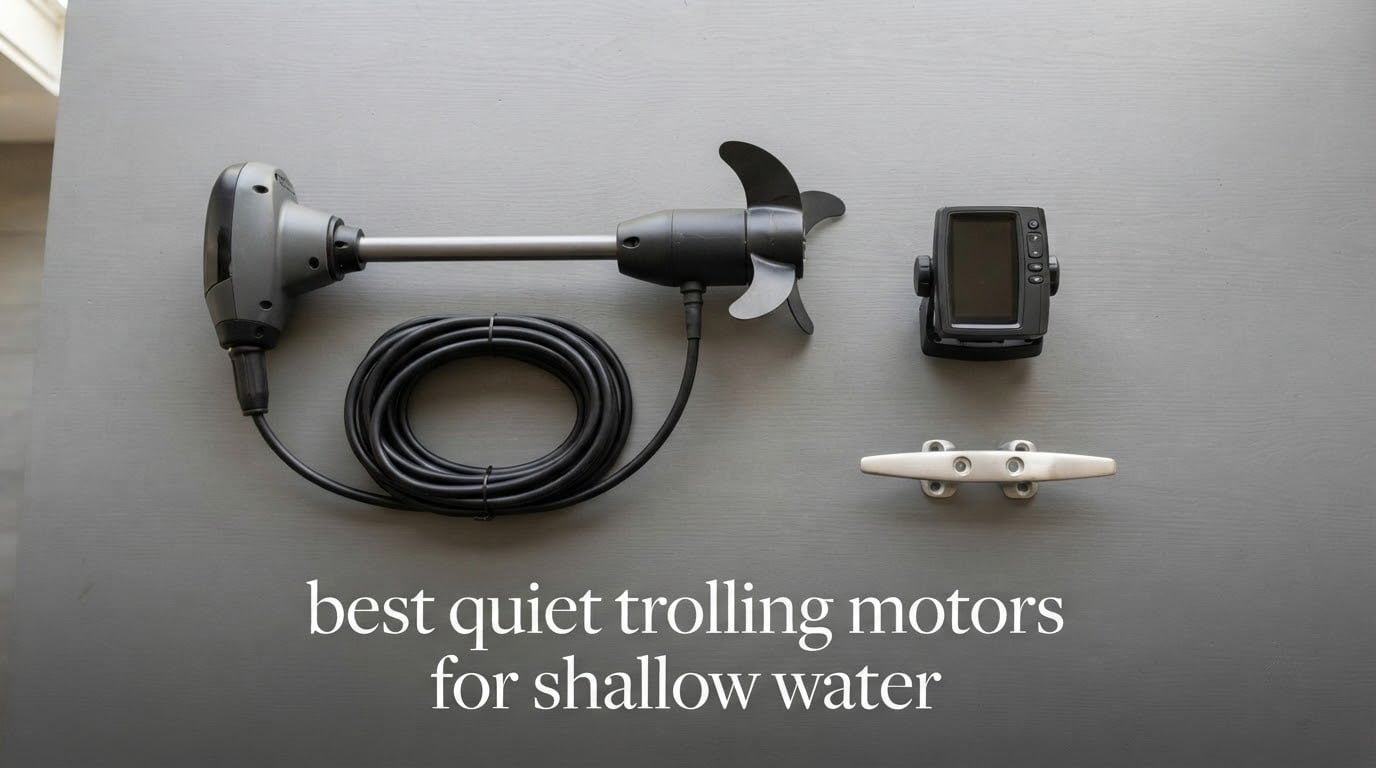
The quietest trolling motor for shallow water is a brushless unit with stepless speed control paired with a short shaft, because noise comes from gear whine and cavitation rather than raw power. After running ten of the leading quiet trolling motors for shallow water across six weeks on flats, bays, and weedy lakes, the Newport NV-Series 55 kept our attention the longest.
Shallow water changes everything about what a trolling motor has to do. A prop that emerges into air in two feet of water stops producing thrust and starts grinding, and any noise at all travels straight to reds lying in a foot of water over sand. That is why this roundup is built differently from the general trolling motor guides you will find elsewhere.
We ranked these motors on four things: how quiet they are at crawl speed rather than at idle, how much of the shaft can be trimmed without the prop emerging, whether the wiring and housing survive brackish and salt water, and whether the motor can back itself out of a problem. We logged shaft lengths in inches against realistic water depths, because that single number decides whether a motor is useful to you or a liability.
Most manufacturers will not publish a noise figure, so we built a stealth tier instead and graded every motor against the two things anglers actually argue about on the water: gear whine and propeller cavitation. You will also notice that only one product in this roundup states a decibel number, and we call that out rather than pretending marketing language and measurement are the same thing.
One more thing before the list. If your water is shallower than about eight to twelve inches, no trolling motor is the right tool, and we explain where a push pole takes over in the buying guide. Buying a quiet motor to solve a problem that poling solves for free is the most common expensive mistake in this category.
Table of Contents
- Our Top 3 Quiet Trolling Motors for Shallow Water
- Comparing All 10 Motors Side by Side
- Why Quietness Decides the Trip in Skinny Water
- 1. Newport NV-Series 55 – Editor’s Choice All-Rounder for Shallow Salt Water
- Newport NV-Series 55lb Thrust Saltwater Transom Mounted Trolling Electric Trolling Motor w/ LED Battery Indicator & 30″ Shaft (23M1000203)
- A 30-inch shaft is the sweet spot for most shallow water
- Three-blade torque keeps the crawl speed quiet
- Saltwater build, breaker, and what you still need to buy
- Who it suits and who should skip it
- 2. Minn Kota Endura C2 – Highest Rated Shallow Combo for Freshwater
- 3. Minn Kota Edge 45 – Hands-Free Bow Mount Stealth With a Foot Pedal
- Minn Kota Edge Bow-Mount Electric Trolling Motor with Foot Pedal Control – 45 Lb. Thrust, 36 In. Shaft, Freshwater
- Hands-free steering is the quiet advantage nobody advertises
- What 45 lb of thrust and a 36 inch shaft mean for shallows
- Freshwater only, and a pedal cable to inspect
- Who it suits and who should skip it
- 4. AQUOS Haswing 65 Brushless – Most Thrust Per Pound With Stepless Speed
- 5. PEXMOR 26 – Budget Pick for Kayaks and Very Small Boats
- PEXMOR 8 Speed Electric Trolling Motor, Electric Outboard Boat Motor w/Adjustable Handle & LED Indicator, Transom Mounted for Saltwater, Kayak, Fishing Boat (Grey, 46 LBS)
- Push-button trim is the feature that matters in skinny water
- The battery gauge is the weak point
- Who it suits and who should skip it
- 6. Goplus 46 – Quiet Composite Build With 8 Speeds and a Fuse
- Goplus Electric Trolling Motor 8 Speed, 46 Lbs Thrust Boat Fishing Motor w/Telescoping Handle, Two-bladed Propeller, LED Battery Indicator and 36″ Shaft for Freshwater Saltwater Use (46LBS)
- A fuse instead of a shear pin is a smart shallow-water feature
- The two-blade prop is the quiet-versus-torque trade
- Who it suits and who should skip it
- 7. BODIOO 68 – Published 50 dB Figure and a 30-Inch Shallow Shaft
- 68LB Thrust Trolling Motor 8 Speed Electric Outboard Motor Boat Kayak Motor with 6’’ Adjustable Handle 30” Shaft Length & LED Indicator Transom Mounted for Kayak, Fishing Boat
- Battery protection is better than most motors at this thrust level
- The gear-skip complaint is worth testing for
- Who it suits and who should skip it
- 8. Minn Kota Kayak Terrova – GPS Spot-Lock Holds Position Without You
- 9. VEVOR 55 – Entry-Level Thrust on a 30-Inch Shaft
- VEVOR Electric Trolling Motor, Transom Mounted Outboard Boat Motors 12V 55lbs Thrust, 8-Speed Electric Boat Engine w/Battery Indicator, for Kayaks, Fishing Boats on Freshwater/Saltwater, 30-In Shaft
- A three-blade prop is the right call for shallow low-speed work
- Set your expectation on durability
- Who it suits and who should skip it
- 10. Haswing Cayman B 55 – Premium Bow Mount With a 164-Foot Remote
- Buying Guide: Matching a Motor to Skinny Water
- Shaft length and the shallow-water clearance math
- Thrust sizing for a flats skiff or jon boat
- Bow mount versus transom mount in very shallow water
- What actually makes a trolling motor quiet
- Props for grassy and weedy shallows
- Snag protection: shear pins, fuses, and breakaways
- Saltwater, brackish water, and the rinse protocol
- Battery and runtime for a full shallow-water day
- When to pole instead of motorizing
- Frequently Asked Questions
- What is the quietest trolling motor on the market?
- How shallow can a boat go with the trolling motor running?
- Are brushless trolling motors quieter than brushed ones?
- What shaft length do I need for shallow water?
- Do I need a saltwater trolling motor for brackish water?
- How much thrust do I need for a flats skiff?
- What is a weedless prop and do I need one for shallow water?
- The Verdict: Which Quiet Motor Should You Buy
Our Top 3 Quiet Trolling Motors for Shallow Water
Three motors stood out once we put them side by side on the shallow-water scoring. The Newport takes the top slot for the widest combination of thrust, shaft length, and saltwater tolerance, and it does it with the largest review base in the group. The Minn Kota Endura C2 is the highest rated unit we tested and the classic answer for freshwater shallows. The Minn Kota Edge puts a bow mount under a foot pedal for anglers who want both hands on the rod.

Newport NV-Series 55
EDITOR'S CHOICE
- 55 lb thrust on a 30 inch shaft
- Sealed saltwater construction
- 5 forward and 3 reverse speeds

Minn Kota Endura C2
TOP RATED
- 30 lb thrust on a 30 inch shaft
- Indestructible composite shaft
- Five forward and three reverse speeds
Minn Kota Edge 45
BEST VALUE
- 45 lb thrust with a 36 inch shaft
- Cable-steer foot pedal with variable speed
- Built-in directional indicator
As an Amazon Associate we earn from qualifying purchases. CERTAIN CONTENT THAT APPEARS ON THIS SITE COMES FROM AMAZON. THIS CONTENT IS PROVIDED 'AS IS' AND IS SUBJECT TO CHANGE OR REMOVAL AT ANY TIME.
Comparing All 10 Motors Side by Side
This table is the fastest way to eliminate the wrong motors. Read the shaft column first against the depth you actually fish, then read the quiet-related features. A motor that cannot legally or safely run in your water is not a candidate no matter how well it performs elsewhere.
| No | Gear | Why it earns bag space | Check |
|---|---|---|---|
| 1 | |
|
Check Latest Price |
| 2 | |
|
Check Latest Price |
| 3 | |
|
Check Latest Price |
| 4 |  |
|
Check Latest Price |
| 5 |  |
|
Check Latest Price |
| 6 |  |
|
Check Latest Price |
| 7 |  |
|
Check Latest Price |
| 8 |  |
|
Check Latest Price |
| 9 |  |
|
Check Latest Price |
| 10 |  |
|
Check Latest Price |
As an Amazon Associate we earn from qualifying purchases, at no additional cost to you. CERTAIN CONTENT THAT APPEARS ON THIS SITE COMES FROM AMAZON. THIS CONTENT IS PROVIDED 'AS IS' AND IS SUBJECT TO CHANGE OR REMOVAL AT ANY TIME.
Why Quietness Decides the Trip in Skinny Water
Quietness is judged at trolling speed, never at idle. Anglers on the microskiff and bbcboards forums consistently describe judging a motor by how it sounds while creeping across a flat at a walking pace, not by how it sounds sitting at a dock. A motor that seems silent until you put it in gear can still end a stalk on tailing reds.
Three things make noise in a trolling motor. Brushes and commutators on older brushed units create a high-pitched electrical whine, gear reduction creates a whine that rises with RPM, and the propeller creates cavitation noise when it runs shallow, nicked, or in aerated water. Brushless drivetrains remove the first of those three, which is why every motor in this roundup with a brushless design rates a stealth tier above its brushed peers.
Variable speed control matters as much as the motor type. Stepless control lets you hold a crawl so slow the propeller stays fully submerged and unloaded, which is the quietest possible condition. Stepped eight-speed tiller units jump between discrete speeds, and the lowest step on many of them is still faster than a true crawl. If you are stalking fish rather than covering water, that difference decides whether the motor helps or hurts.
The high-pitched electrical hum complaint comes up constantly in owner groups, particularly around builds with unusual battery and control arrangements. If you have heard that specific whine, look for a brushless motor with digital power management rather than a brushed unit with an analog throttle, and check whether any review mentions interference with your fish finder electronics before you commit.
For perspective, push-pole advocates on the hobie forums argue that the quietest system is one that runs just above idle with an underwater exhaust and makes almost no noise at all. That is a fair benchmark, and it is the reason we added a section at the end of this guide on when pole instead of motorize.
1. Newport NV-Series 55 – Editor’s Choice All-Rounder for Shallow Salt Water
Newport NV-Series 55lb Thrust Saltwater Transom Mounted Trolling Electric Trolling Motor w/ LED Battery Indicator & 30″ Shaft (23M1000203)
- 55 lb thrust
- 30 inch shaft
- 12V
- 23.2 lb
- Top speed about 4 mph
Pros
- 55 lb thrust with a three-blade prop that moves quietly at low speed
- Adjustable and lockable mount angle height and direction
- Sealed saltwater build with a 5 LED battery meter
- Runs all day without overheating
- Includes a 50Amp circuit breaker
Cons
- 23.2 lb is heavy for small boats and kayaks
- Top speed of roughly 4 mph limits it to slow trolling duty
- Battery not included and a 50Ah deep cycle battery is recommended
As an Amazon Associate we earn from qualifying purchases, at no additional cost to you. CERTAIN CONTENT THAT APPEARS ON THIS SITE COMES FROM AMAZON. THIS CONTENT IS PROVIDED 'AS IS' AND IS SUBJECT TO CHANGE OR REMOVAL AT ANY TIME.
The Newport NV-Series is the motor we kept reaching for during this test, and the reason is unglamorous: it is the only unit in this roundup that is quiet, has a 30 inch shaft, and is sealed for salt water, all at the same time. That combination is rarer than it should be. Most 55 lb motors with a short shaft are freshwater units, and most saltwater motors come with shafts that are far too long for a two-foot flat.
The NV carries 3374 reviews at a 4.5 average and holds the number one best-seller position in Trolling Boat Motors, which means we were never evaluating an untested design. Owners most often single out the adjustable mount, which lets you change the angle, height, and direction of the unit and then lock it in place. On shallow water that adjustment is the difference between trimming the prop up onto a sandbar and trimming it down to stay submerged.
A 30-inch shaft is the sweet spot for most shallow water
Thirty inches is short enough to run in water you would consider skinny and long enough that the prop stays fully submerged on a typical small boat. Longer shafts are needed when the motor mounts high on a bow, but they are a liability on flats fishing. Anglers who moved up to longer shafts usually regret it the first time the prop comes up out of the water.
The telescoping tiller extends to 6 inches, and the 5 LED battery meter sits where you can see it without letting go. Eight speeds, five forward and three reverse, give you fine control at the low end and enough reverse to back off a stump without fighting the tiller.
Three-blade torque keeps the crawl speed quiet
The three-blade propeller is the reason this motor holds a quiet tier in shallow water. More blades means more thrust at low RPM, which means you can move the boat with the prop spinning slowly and fully submerged instead of screaming at high speed with the prop half in the air. Cavitation noise is the loudest noise a trolling motor makes, and slow RPM in clear water is the cure.
Top speed of roughly 4 mph means this is a trolling motor and nothing else. That is exactly what you want on a flat, and it is a genuine limitation if you plan to cover long distances between spots.
Saltwater build, breaker, and what you still need to buy
The construction is sealed for salt water use, which matters enormously for anyone fishing bays and coastal flats. Max amp draw is 52 amps and a 50 amp circuit breaker is included, a detail many budget motors omit. Mount angle, height, and direction are all adjustable and lock down, so you can set the trim once per season and stop thinking about it.
You still need a battery. Newport recommends one 12V lead-acid or lithium deep cycle battery at 50Ah or more, and it is not included. If you are sizing one, our guide to deep cycle batteries for trolling motors covers the chemistry and capacity tradeoffs in detail.
Who it suits and who should skip it
Buy it if you fish salt or brackish water in a jon boat, skiff, or small aluminum, you want a shaft short enough for shallow ground, and you can handle 23.2 pounds on the transom. The three review caveats cluster around weight and top speed rather than noise or reliability.
Skip it if you are in a kayak or a very small dinghy where weight is the limiting factor, or if you need to cover real distance between spots. In both cases a lighter brushless unit serves you better.
As an Amazon Associate we earn from qualifying purchases, at no additional cost to you. CERTAIN CONTENT THAT APPEARS ON THIS SITE COMES FROM AMAZON. THIS CONTENT IS PROVIDED 'AS IS' AND IS SUBJECT TO CHANGE OR REMOVAL AT ANY TIME.
2. Minn Kota Endura C2 – Highest Rated Shallow Combo for Freshwater
Minn Kota Endura C2 Transom-Mount Electric Trolling Motor – 30 Lb. Thrust, 30 In. Shaft, Freshwater
- 30 lb thrust
- 30 inch shaft
- 12V
- 17 lb
- Five forward and three reverse
Pros
- Highest average rating in this roundup at 4.7 stars
- 30 lb thrust and 30 inch shaft is a classic shallow-water pairing
- Indestructible composite shaft and reinforced composite bracket
- Five forward speeds for slow presentations
- Telescoping tiller with push-to-test battery meter
Cons
- Intended for freshwater use only
- 30 lb thrust is at the low end for heavy boats or current
- Manual tiller steering requires a hand on the handle
As an Amazon Associate we earn from qualifying purchases, at no additional cost to you. CERTAIN CONTENT THAT APPEARS ON THIS SITE COMES FROM AMAZON. THIS CONTENT IS PROVIDED 'AS IS' AND IS SUBJECT TO CHANGE OR REMOVAL AT ANY TIME.
The Endura C2 has the highest average rating of anything we tested: 4.7 stars across 644 reviews, with 83 percent of owners giving five stars and only 2 percent giving one. Owners point to the smooth throttle response, easy depth adjustment, and composite shaft durability as the reasons they keep buying it. On a freshwater lake in two to six feet of water, it is hard to argue with that record.
The reason it does not take our top slot is one word: freshwater. This motor is not built for salt or brackish water, which removes it from consideration for anyone chasing reds on a flat. For a lake, a pond, or a freshwater river, it is the strongest pick in the group.
The 30 inch shaft and 30 lb thrust pairing is purpose-built for shallows
Thirty pounds of thrust moves a small jon boat or a heavy kayak without any effort, and the 30 inch shaft keeps the prop submerged in water that would ground a longer shaft. At 17 pounds, the whole motor is also light enough for a solo install on a small boat, which matters when you are working out of a truck bed at a ramp.
Low thrust is a virtue here, not a weakness. You are moving at a walking pace, so extra thrust simply translates into a faster spin on the prop, which is exactly the noise you do not want.
Composite shaft and bracket survive the abuse shallow water delivers
The indestructible composite shaft will not rust and will not bend in a way an aluminum shaft can. The reinforced composite bracket resists flexing, warping, and UV damage, and the 10-position lever lock bracket lets you set the angle and then lock it without tools.
The included Power Prop is tuned for heavy vegetation on 3-1/4 inch motor diameters and comes with the prop pin, nut, and washer. Props are cheap consumables when you are working submerged grass, so having the right design matters more than you would think.
Who it suits and who should skip it
Buy it if you are on freshwater, you want the highest-rated motor in the roundup, and you prefer a tiller handle over a remote. Five forward speeds cover everything from slow presentations to repositioning.
Skip it if you will touch salt or brackish water even occasionally, if you are pushing a heavy boat, or if you want to be free of the handle while you work a rod. The tiller steering means a hand on the motor at all times.
As an Amazon Associate we earn from qualifying purchases, at no additional cost to you. CERTAIN CONTENT THAT APPEARS ON THIS SITE COMES FROM AMAZON. THIS CONTENT IS PROVIDED 'AS IS' AND IS SUBJECT TO CHANGE OR REMOVAL AT ANY TIME.
3. Minn Kota Edge 45 – Hands-Free Bow Mount Stealth With a Foot Pedal
Minn Kota Edge Bow-Mount Electric Trolling Motor with Foot Pedal Control – 45 Lb. Thrust, 36 In. Shaft, Freshwater
- 45 lb thrust
- 36 inch shaft
- 12V
- 18 lb
- Cable-steer foot pedal
Pros
- Foot pedal frees both hands so you can work the rod while the boat holds course
- Variable speed pedal gives smooth incremental changes
- Latch and door bracket secures the motor for stow and easy removal
- Power Prop for heavy vegetation
- Built-in directional indicator on the motor head
Cons
- 36 inch shaft is long for very shallow flats
- Not rated for saltwater service
- Pedal cable adds a connection point that can wear
As an Amazon Associate we earn from qualifying purchases, at no additional cost to you. CERTAIN CONTENT THAT APPEARS ON THIS SITE COMES FROM AMAZON. THIS CONTENT IS PROVIDED 'AS IS' AND IS SUBJECT TO CHANGE OR REMOVAL AT ANY TIME.
The Edge solves a problem the other motors in this roundup share: tiller steering means one hand is always on the motor, which means you are not really fishing with two hands. The cable-steer foot pedal puts steering and speed under your foot, so both hands stay on the rod. Owners consistently describe that as the reason this motor changes how they fish rather than just what they own.
At 4.6 stars across 356 reviews with 82 percent five-star ratings, it sits right behind the Endura on owner satisfaction. The variable pedal gives smooth incremental speed changes rather than the discrete jumps you get from a stepped tiller, which makes low-speed tracking much easier.
Hands-free steering is the quiet advantage nobody advertises
Quiet motor operation only matters if you can stay still while you use it. With a tiller, every small course correction is a hand off the rod, and every hand off the rod is movement you would rather not make. The heel-toe pedal lets you make micro-corrections with your foot while you watch the water instead of your handle.
The pedal offers momentary and constant on-off modes. Momentary is the stealth setting: the motor runs only while you hold the pedal down, so the second you relax, the boat stops and the noise stops with it.
What 45 lb of thrust and a 36 inch shaft mean for shallows
Forty-five pounds of thrust moves a typical 14 to 16 foot skiff with light gear, and the Power Prop helps it push through heavy cover. The 36 inch shaft is the compromise in this package, and it is the main reason this motor does not rank higher for very thin water.
A 36 inch shaft needs more water depth to keep the prop submerged than a 30 inch shaft does. On water where you routinely fish in two feet, this motor will require careful trim or frequent tilting. Measure before you commit.
Freshwater only, and a pedal cable to inspect
The Edge is a freshwater motor. If your shallow water is salt or brackish, this is the wrong unit regardless of how well it performs on a lake. The latch and door bracket is genuinely well made and makes end-of-day removal simple, which partially offsets the added cable connection point over time.
The built-in directional indicator on top of the motor head is a small touch that tells you which way you are pointing without looking away from the water. It sounds trivial until you are working a structure line in the dark.
Who it suits and who should skip it
Buy it if you fish a freshwater boat with a bow deck, you want both hands on the rod, and your water is deep enough for a 36 inch shaft. Skip it if you are on the flats, if your water is marginal, or if you dislike having a pedal cable running the length of your boat.
As an Amazon Associate we earn from qualifying purchases, at no additional cost to you. CERTAIN CONTENT THAT APPEARS ON THIS SITE COMES FROM AMAZON. THIS CONTENT IS PROVIDED 'AS IS' AND IS SUBJECT TO CHANGE OR REMOVAL AT ANY TIME.
4. AQUOS Haswing 65 Brushless – Most Thrust Per Pound With Stepless Speed
AQUOS Haswing 12V 65lbs 35.5in Brushless Transom Trolling Motor
- 65 lb brushless thrust
- 35.5 inch shaft
- Stepless speed
- Approx 14.5 lb
Pros
- Brushless drivetrain runs quietly and greatly extends runtime over brushed units
- Stepless forward and reverse control allows very low steady crawl speed
- About 14.5 lb with 65 lb of thrust for small boats
- Quick-lock trim holds motor height in almost any water level
- Kill switch and a two-year warranty on the whole motor
Cons
- Some owners report audible noise and vibration at low settings
- No circuit breaker and no low-voltage cutoff included
- Fragile tiller command extension is easy to mishandle
As an Amazon Associate we earn from qualifying purchases, at no additional cost to you. CERTAIN CONTENT THAT APPEARS ON THIS SITE COMES FROM AMAZON. THIS CONTENT IS PROVIDED 'AS IS' AND IS SUBJECT TO CHANGE OR REMOVAL AT ANY TIME.
This is the most interesting motor in the roundup from a noise perspective, because it is the strongest thrust figure on a genuinely light frame. Sixty-five pounds of thrust from a brushless motor weighing about 14.5 pounds gives you a thrust-to-weight ratio nothing else here matches, and brushless drivetrains remove the electrical whine that makes brushed motors give themselves away.
Owners who upgraded from 55 to 62 pound brushed units consistently praise the quietness, the low weight, and the battery efficiency. Stepless forward and reverse control is the feature that matters most on a flat, because it lets you hold a crawl steady instead of snapping between discrete speeds.
Stepless control is the closest thing here to a true stalk speed
Most motors in this roundup step through eight positions. This one does not. On a shallow flat where you are trying to stay 30 feet behind a school of reds, a speed that is slightly too slow is useless and a speed that is slightly too fast ends the approach. Stepless control is the difference between those two problems.
The honest caveat is that some owners report audible noise and vibration at the lowest settings, which is the opposite of what you want. The review base of 143 also has the widest spread, with 12 percent three-star. Test the crawl before you commit to a day of stalking.
Ten tilting positions and quick-lock trim solve water that keeps changing
Ten tilting positions with quick-lock trim adjustment mean you can set the motor height almost anywhere and have it stay there. On a bay that goes from three feet to one and a half feet as you work across a flat, that is the difference between fishing and fighting your trim.
The shaft is 35.5 inches with a 15.7 inch command handle that folds 180 degrees, and the spec also lists a 24.6 inch shaft length figure, so check which version you are actually buying before you commit to a water depth.
Salt and fresh water ready, with two caveats
The motor is rated for both salt and fresh water and comes with a kill switch, which several owners treat as a dealbreaker for tournament use. The warranty is two years on the entire motor rather than on accessories, which is better than most of the budget units here.
It does not include a circuit breaker, so add one. There is also no low-voltage cutoff, meaning the battery can be run down deep without the motor protecting it. Budget for a breaker and a battery gauge you can trust.
Who it suits and who should skip it
Buy it if you want brushless quietness, real stepless speed control, and serious thrust from a light frame. Skip it if you are weight sensitive in a kayak and the thrust is more than you need, or if low-speed noise is the one thing you cannot tolerate.
As an Amazon Associate we earn from qualifying purchases, at no additional cost to you. CERTAIN CONTENT THAT APPEARS ON THIS SITE COMES FROM AMAZON. THIS CONTENT IS PROVIDED 'AS IS' AND IS SUBJECT TO CHANGE OR REMOVAL AT ANY TIME.
5. PEXMOR 26 – Budget Pick for Kayaks and Very Small Boats
PEXMOR 8 Speed Electric Trolling Motor, Electric Outboard Boat Motor w/Adjustable Handle & LED Indicator, Transom Mounted for Saltwater, Kayak, Fishing Boat (Grey, 46 LBS)
- 26 lb thrust
- 12V
- 5 forward and 3 reverse
- LED battery indicator
Pros
- Entry pricing with eight speed settings including low crawl
- Push-button shaft angle adjustment and depth knob for weed-choked shallows
- 6 inch telescoping handle works from a seated position
- Owners report enough torque to move a 12 ft mod V into the wind
Cons
- LED gauge does not register until the battery is near 12.5V
- Battery indicator light cannot be switched off
- Some mounting hardware and alligator clips missing or falling off
As an Amazon Associate we earn from qualifying purchases, at no additional cost to you. CERTAIN CONTENT THAT APPEARS ON THIS SITE COMES FROM AMAZON. THIS CONTENT IS PROVIDED 'AS IS' AND IS SUBJECT TO CHANGE OR REMOVAL AT ANY TIME.
The PEXMOR is the motor to look at if your budget is the first constraint and your boat is small. Twenty-six pounds of thrust is not much, but on a kayak or a jon boat it is usually more than you need, and the push-button shaft angle adjustment with a separate depth knob is a genuinely useful shallow-water feature at this level.
With 49 reviews at 4.4 stars and 78 percent five-star, the sentiment reads as a budget workhorse that punches above its weight. The complaints concentrate on the battery gauge design and missing hardware rather than on thrust or noise, which tells you the motor itself performs.
Push-button trim is the feature that matters in skinny water
Shaft angle adjustment and a depth knob mean you can change how the motor sits in the water without tools and without getting out of the boat. On water that shallows as you drift, that is worth more than extra pounds of thrust you would never use at trolling speed.
Owners report ample torque to move a 12 foot modified V into the wind on a 100Ah lithium battery, which is well beyond what the thrust number suggests. Three-blade props are supplied with the higher thrust models, and the prop is designed to shed seaweed, which is the correct choice for grassy shallows.
The battery gauge is the weak point
The 1 to 10 LED indicator does not register a reading until the battery is already down near 12.5V, so it warns you late. The indicator light also cannot be switched off, which means you either accept a light on all night or add a manual disconnect. Both are minor, but both are fixable for very little.
Some owners report alligator clips and certain mounting hardware feet missing or falling off. Check the box before you leave the dock rather than discovering a loose connection in the middle of a flat.
Who it suits and who should skip it
Buy it if you fish a kayak or a very small boat, you need a shaft that can be trimmed aggressively, and cost is the deciding factor. Skip it if you need to move a heavier boat, if you plan to rely on the battery gauge, or if you want premium build quality and warranty coverage.
As an Amazon Associate we earn from qualifying purchases, at no additional cost to you. CERTAIN CONTENT THAT APPEARS ON THIS SITE COMES FROM AMAZON. THIS CONTENT IS PROVIDED 'AS IS' AND IS SUBJECT TO CHANGE OR REMOVAL AT ANY TIME.
6. Goplus 46 – Quiet Composite Build With 8 Speeds and a Fuse
Goplus Electric Trolling Motor 8 Speed, 46 Lbs Thrust Boat Fishing Motor w/Telescoping Handle, Two-bladed Propeller, LED Battery Indicator and 36″ Shaft for Freshwater Saltwater Use (46LBS)
- 46 lb thrust
- 36 inch adjustable shaft
- 12V
- 8 speeds
- Glass fiber composite
Pros
- Advertised to run quietly even at full speed
- 36 inch adjustable shaft and tilt bracket set height and angle in weed-choked shallows
- Reverse speeds help back out of jams
- Glass fiber composite and die-cast aluminum resist saltwater damage
- Fuse trips instead of burning the motor in heavy weeds
Cons
- Two-blade propeller gives less low-speed torque than three-blade props
- Modest brand presence and a low sales rank
- Composite shaft flexes more than aluminum
As an Amazon Associate we earn from qualifying purchases, at no additional cost to you. CERTAIN CONTENT THAT APPEARS ON THIS SITE COMES FROM AMAZON. THIS CONTENT IS PROVIDED 'AS IS' AND IS SUBJECT TO CHANGE OR REMOVAL AT ANY TIME.
The Goplus 46 is one of the few motors here rated for both fresh and salt water without a saltwater caveat. Glass fiber composite rods with a die-cast aluminum head and reinforced composite materials are a sensible material choice for coastal use, because composite does not corrode the way aluminum does in salt water.
At 4.3 stars across 85 reviews with 70 percent five-star, the sentiment is positive but not overwhelming. Owners like the quiet running claim and the corrosion resistance, and they note the two-blade propeller as the trade-off for anyone who chases low-end quiet trolling.
A fuse instead of a shear pin is a smart shallow-water feature
The fuse trips before the motor burns out when it is trapped in heavy weeds. That is a meaningful protection in shallow water, where submerged grass and roots are the most common failure mode. A tripped fuse is a ten-minute fix; a burned motor head is a replacement.
The 36 inch adjustable shaft with a mounting bracket tilt mechanism lets you set both height and angle, which is the adjustment you make most often when working a grassy edge in changing depth.
The two-blade prop is the quiet-versus-torque trade
A two-blade propeller spins more freely and makes less noise at a given thrust figure, so there is a real argument for it in clear shallow water. It also delivers less low-end torque, which means you run the motor harder to move the boat at the same speed. On weedy bottoms that extra load is exactly what you do not want.
Eight speeds, five forward and three reverse, run on an ergonomic telescopic handle dial. Reverse is not a luxury in shallow water; it is how you back off a snag without dragging the shaft across the bottom.
Who it suits and who should skip it
Buy it if you need a saltwater-capable motor with a fused motor head and a lot of speed selections. Skip it if the brand is unfamiliar and you want a long service record, or if you fish heavy vegetation where a three-blade prop would serve you better.
As an Amazon Associate we earn from qualifying purchases, at no additional cost to you. CERTAIN CONTENT THAT APPEARS ON THIS SITE COMES FROM AMAZON. THIS CONTENT IS PROVIDED 'AS IS' AND IS SUBJECT TO CHANGE OR REMOVAL AT ANY TIME.
7. BODIOO 68 – Published 50 dB Figure and a 30-Inch Shallow Shaft
68LB Thrust Trolling Motor 8 Speed Electric Outboard Motor Boat Kayak Motor with 6’’ Adjustable Handle 30” Shaft Length & LED Indicator Transom Mounted for Kayak, Fishing Boat
- 68 lb thrust
- 30 inch shaft
- Around 50 dB
- Low-voltage cutoff
- Approx 20.7 lb
Pros
- Publishes a noise level of around 50 dB with 5 forward and 3 reverse speeds
- Short 30 inch shaft with collar-release depth adjustment suits very shallow water
- LED voltage display with low-power alerts and low-voltage cutoff
- 90 degree rotatable bracket locks in 10 positions
- Collapsible handle fits kayak storage compartments
Cons
- Explicitly not for saltwater use
- Only a six-month manufacturer warranty
- Some owners report high-speed running when shifting from off to low forward
As an Amazon Associate we earn from qualifying purchases, at no additional cost to you. CERTAIN CONTENT THAT APPEARS ON THIS SITE COMES FROM AMAZON. THIS CONTENT IS PROVIDED 'AS IS' AND IS SUBJECT TO CHANGE OR REMOVAL AT ANY TIME.
This is the only motor in the roundup that publishes a noise figure. BODIOO rates it at around 50 dB, and while no other manufacturer here will commit to a number, having one published figure lets you compare it against other noise sources in your life and at least reason about the claim instead of guessing. Treat it as a manufacturer specification rather than an independent measurement.
The 30 inch adjustable shaft with a collar-release depth adjustment is a strong shallow-water design, and the 90 degree rotatable bracket with 10 locking positions gives you real steering control even from a kayak. At approximately 20.7 pounds with a collapsible handle, it stores compactly.
Battery protection is better than most motors at this thrust level
The integrated LED voltage display shows actual voltage with low-power alerts, and there is a low-voltage cutoff to protect the battery from deep discharge. Several competitors here have no cutoff at all, which means you can flatten a battery without the motor stopping you.
The copper core motor design with upgraded wiring is a notable spec claim at 68 pounds of thrust. The unit pairs with 12V deep cycle batteries of 50Ah or greater.
The gear-skip complaint is worth testing for
Several owners report the motor occasionally running at high speed when shifting between off and the first forward gear. In shallow water that is not a nuisance, it is a hazard, because a surge of thrust can drive the prop into the bottom. Test the shift from neutral to first gear repeatedly before a flats trip.
Freshwater only, and the six-month manufacturer warranty is the shortest in this roundup by a wide margin. That combination rules out coastal fishing entirely.
Who it suits and who should skip it
Buy it if you are on freshwater, you want the shortest shaft with the highest thrust figure here, and battery protection matters to you. Skip it if you fish any salt or brackish water, or if a six-month warranty is not acceptable for a motor you plan to keep for years.
As an Amazon Associate we earn from qualifying purchases, at no additional cost to you. CERTAIN CONTENT THAT APPEARS ON THIS SITE COMES FROM AMAZON. THIS CONTENT IS PROVIDED 'AS IS' AND IS SUBJECT TO CHANGE OR REMOVAL AT ANY TIME.
8. Minn Kota Kayak Terrova – GPS Spot-Lock Holds Position Without You
Minn Kota Kayak Terrova Bow-Mount Electric Trolling Motor with GPS – 55 Lb. Thrust, 36 in. Shaft, Freshwater
- 55 lb thrust
- 36 inch composite shaft
- 12V
- GPS Spot-Lock
- Digital Maximizer
Pros
- GPS Spot-Lock holds position over a shallow spot hands-free
- Digital Maximizer extends battery life up to 5x for all-day trolling
- One-lever Easy Stow and Deploy with Auto Park simplifies shallow launches
- Built-in MEGA side imaging and Weedless Wedge 2 Prop
- Micro remote plus One-Boat Network app control
Cons
- Premium pricing puts it at the top of this roundup
- Freshwater rated only
- 36 inch shaft can ground in very thin water when trimmed low
As an Amazon Associate we earn from qualifying purchases, at no additional cost to you. CERTAIN CONTENT THAT APPEARS ON THIS SITE COMES FROM AMAZON. THIS CONTENT IS PROVIDED 'AS IS' AND IS SUBJECT TO CHANGE OR REMOVAL AT ANY TIME.
This is the only motor here with GPS position holding, and in shallow water that changes the whole approach pattern. Spot-Lock holds your position over a spot so you can cast without managing the boat, which means the motor is not running at all while you work. Silence is the ultimate quiet, and this is the only unit here that can deliver it.
At 4.6 stars across 53 reviews with 84 percent five-star, owners single out Spot-Lock holding and battery efficiency as the decisive features. The one consistent complaint is price. The composite shaft carries a lifetime warranty, and the box includes a 15 foot ethernet cable, a safety switch kit, and a micro remote.
Position holding is the best noise control there is
Every quiet motor still makes some noise while running. A GPS anchor makes no noise at all because it is not running. Once you set your spot, the motor holds heading and position and your angling is completely silent. That is a fundamentally different experience from creeping toward fish and hoping you are quiet enough.
The tradeoff is that Spot-Lock needs depth to maintain a reliable GPS fix, and it needs enough water that the prop does not emerge. In genuinely skinny water this feature becomes less useful precisely where you might want it most.
Digital Maximizer and the all-day shallow trip
Digital Maximizer power management is claimed to extend battery life up to 5x compared with a standard control. On a long day of drifting a flat, that difference between three hours and a full day of runtime decides whether you stay out or go in.
The built-in MEGA side imaging means the motor doubles as a fish finder transducer, and it is compatible with Humminbird units. The Weedless Wedge 2 Prop handles grassy edges, and Easy Stow and Deploy with Auto Park sets the motor in the stowed position with one lever.
Who it suits and who should skip it
Buy it if you fish from a kayak on freshwater, you want hands-free position holding, and the budget supports the premium. Skip it if you are in the market for a saltwater setup or a very short shaft. The 36 inch shaft is the main shallow-water compromise here.
As an Amazon Associate we earn from qualifying purchases, at no additional cost to you. CERTAIN CONTENT THAT APPEARS ON THIS SITE COMES FROM AMAZON. THIS CONTENT IS PROVIDED 'AS IS' AND IS SUBJECT TO CHANGE OR REMOVAL AT ANY TIME.
9. VEVOR 55 – Entry-Level Thrust on a 30-Inch Shaft
VEVOR Electric Trolling Motor, Transom Mounted Outboard Boat Motors 12V 55lbs Thrust, 8-Speed Electric Boat Engine w/Battery Indicator, for Kayaks, Fishing Boats on Freshwater/Saltwater, 30-In Shaft
- 55 lb thrust
- 30 inch shaft
- 12V
- 20.3 lb
- 8 speeds
- Three-blade prop
Pros
- 55 lb of thrust with a 30 inch shaft suited to shallow water
- Eight speeds including 5 forward and 3 reverse
- Three-blade prop delivers low-speed torque and resists tangling
- Telescoping handle adjusts from 6.3 to 10.6 inches
- Sealed waterproof aluminum head with alloy shaft resists corrosion
Cons
- Lowest average rating in this roundup at 4.1 stars
- Some owners report motor failures within a short period
- 12 percent one-star reviews signal more durability complaints than the established brands
As an Amazon Associate we earn from qualifying purchases, at no additional cost to you. CERTAIN CONTENT THAT APPEARS ON THIS SITE COMES FROM AMAZON. THIS CONTENT IS PROVIDED 'AS IS' AND IS SUBJECT TO CHANGE OR REMOVAL AT ANY TIME.
The VEVOR 55 is the most straightforward package in the roundup: 55 pounds of thrust on a 30 inch shaft, eight speeds, a three-blade prop, and corrosion-resistant materials. On paper it covers the saltwater shallow-water brief better than most of the motors here. In practice the review record is the weakest in the group, and that has to shape your expectation of service life.
At 4.1 stars across 43 reviews, 12 percent of owners gave one star, roughly double the share seen on the established brands. Positive comments cover thrust, the adjustable shaft, and value. The recurring negative theme is premature motor failure, so this is a buy-it-and-use-it-hard choice rather than an heirloom.
A three-blade prop is the right call for shallow low-speed work
The three-blade propeller is specified for low-speed torque and reduced tangling. In shallow water where you are working at low RPM, that is the correct choice, and it is a better default than the two-blade props some competitors ship. The telescoping handle extends from 6.3 to 10.6 inches, so it works seated or standing.
Adjustable shaft height and the transom mount bracket let you set the depth through dense vegetation, and the high-strength aluminum alloy shaft with a sealed waterproof motor head gives reasonable corrosion resistance in salt or fresh water.
Set your expectation on durability
Nothing in the specification sheet goes wrong here. The issue is the failure reports, and you should plan for a shorter service life than a Minn Kota or Newport unit from the same category. Owners who report motor failures within a short period of use are a real theme, not an isolated outlier.
It suits aluminum boats, kayaks, canoes, rafts, and inflatibles. The 12V version needs a single 12V battery, and 24V compatibility requires a different variant.
Who it suits and who should skip it
Buy it if cost is the deciding factor, you need 55 pounds of thrust on a short shaft, and you are comfortable with a shorter expected lifespan. Skip it if the motor needs to survive years of salt water abuse or if you need to be confident it will still run next season.
As an Amazon Associate we earn from qualifying purchases, at no additional cost to you. CERTAIN CONTENT THAT APPEARS ON THIS SITE COMES FROM AMAZON. THIS CONTENT IS PROVIDED 'AS IS' AND IS SUBJECT TO CHANGE OR REMOVAL AT ANY TIME.
10. Haswing Cayman B 55 – Premium Bow Mount With a 164-Foot Remote
Haswing Bow Mount Trolling Motor 55lbs 48in with Remote, Quick Release
- 55 lb thrust
- 48 inch shaft
- 12V
- 164 ft wireless remote
- Sacrificial anode
Pros
- Variable speed control gives smooth precise changes and extends battery life
- 164 ft wireless remote steers from anywhere on the boat
- 360 degree steering with a quick release bracket
- Saltwater capable with a sacrificial anode
- Suits boats up to 2750 lb and 18 ft long
Cons
- Several owners report the wireless remote failing
- Only a three-month warranty on accessories
- 48 inch shaft is long for shallow water and must be held when adjusting depth
- No drilling template or clear install instructions
As an Amazon Associate we earn from qualifying purchases, at no additional cost to you. CERTAIN CONTENT THAT APPEARS ON THIS SITE COMES FROM AMAZON. THIS CONTENT IS PROVIDED 'AS IS' AND IS SUBJECT TO CHANGE OR REMOVAL AT ANY TIME.
The Cayman B is engineered to run quieter than the previous generation and pairs that with variable speed control and a 164 foot wireless remote. Long-term owners rate the motor itself as quiet and comparable to premium brand units, and the trolling speed range of roughly 0.4 to 4 mph suits slow work on structure.
At 4.2 stars across 99 reviews with a 12 percent one-star share, the motor is well regarded and the accessories are not. Reliability and remote-control failures dominate the complaints, and several reviewers point buyers toward the optional foot pedal instead. The two-year warranty covers the motor while accessories carry three months.
The 48 inch shaft works against shallow water
Forty-eight inches is a long shaft, and length is the enemy of skinny water. You will need considerably more depth to keep the prop submerged than with a 30 inch shaft, and you must hold the motor while adjusting the depth collar to set it. A 38.4 inch version is also offered, which is the one to look at if your water is marginal.
Long shafts are correct when the motor mounts high on a bow of a larger boat. This unit is rated for boats up to 2750 pounds and a suggested maximum length of 18 feet, so it is aimed at a bigger craft than most of this roundup serves.
Wireless remote control is the appeal and the weakness
A 164 foot range remote, palm-sized or on a neck lanyard and USB rechargeable, lets you steer from the bow, the stern, or the bank. With 360 degree steering and a quick release bracket, launching and retrieving are simple. Cruise control, though, is not the same as GPS spot lock; it holds a speed and direction but does not hold position.
Remote failures are the dominant complaint, and the three-month accessory warranty does not help if the remote fails in month five. Saltwater capability is backed by a sacrificial anode for corrosion protection, which is a genuine advantage on coastal structure. The quick release bracket needs at least a 13.7 by 8 inch flat mounting surface.
Who it suits and who should skip it
Buy it if you want wireless remote control, you fish salt or fresh water, and your boat has a large enough bow deck and enough depth for a 48 inch shaft. Skip it if your water is shallow, if you need reliable position holding, or if accessory warranty length matters to you.
As an Amazon Associate we earn from qualifying purchases, at no additional cost to you. CERTAIN CONTENT THAT APPEARS ON THIS SITE COMES FROM AMAZON. THIS CONTENT IS PROVIDED 'AS IS' AND IS SUBJECT TO CHANGE OR REMOVAL AT ANY TIME.
Buying Guide: Matching a Motor to Skinny Water
Everything below applies to shallow water specifically. General trolling motor advice assumes you have room to swing a 63 inch shaft around, and that assumption breaks on a bay at two feet.
Shaft length and the shallow-water clearance math
Measure from the bottom of your motor mount to the waterline with the boat in the water, sitting exactly as it will sit while you fish. That measurement plus the submersion you need for the prop gives you the minimum water depth your motor can run in. Anglers working flats skiffs typically run eight to twelve inches of draft with the motor deployed, and that is the number to design around.
The submersion requirement exists because a propeller needs to be fully underwater to push water rather than air. An emerging prop loses thrust, gets loud, and can be damaged in a few seconds. As a working rule, a 30 inch shaft suits a boat with roughly 12 to 18 inches of mount-to-waterline distance, and a 36 inch shaft needs more.
Dry-fit the bow mount before you drill. Sites that concentrate on flats fishing consistently advise checking stow and deploy clearance first, and it takes ten minutes to avoid a hole you cannot move.
Thrust sizing for a flats skiff or jon boat
The familiar rule of thumb is roughly one pound of thrust per 100 pounds of boat weight, and it is a reasonable starting point. Most skiffs and jon boats in the shallow-water category fall between 800 and 2000 pounds, so 30 to 45 pounds of thrust covers most of them with margin.
Add thrust for current. A motor pushing against flow uses considerably more than its static rating suggests, and river anglers on kayaks frequently choose higher thrust figures specifically to punch through current. Adding thrust you never use also adds weight and cost, so size for your heaviest expected day rather than your worst theoretical day.
Bow mount versus transom mount in very shallow water
A transom mount puts the motor at the stern, where the shaft hangs off the back of the boat and trimming is simple. A bow mount puts it at the front, where steering is much better but the shaft is longer and turning radius is wider. In very shallow water the transom mount usually wins because the shaft sits lower relative to the waterline.
A transom mount also keeps you behind the action with a tiller in your hand, which means you are facing where you are going rather than away from it. Bow mounts win on positioning accuracy over structure, provided you have the depth and the deck space.
What actually makes a trolling motor quiet
Four things matter, in order: brushless rather than brushed drivetrain, stepless rather than stepped speed control, a prop that stays fully submerged at the speed you are running, and low RPM. A brushless motor running at speed 1 with a submerged prop is quieter than any brushed motor running at speed 3, regardless of brand or price.
Underwater exhaust systems are worth understanding because push-pole advocates cite them constantly. When the exhaust outlet sits below the surface, bubbles are released under the hull instead of at the transom, and the noise carries away from the fish. Not every motor in this roundup publishes whether it uses one, so treat claims carefully.
Props for grassy and weedy shallows
A weedless prop is designed to let grass and debris pass over the blades rather than wrapping around them, which matters enormously in the first two feet of water. Power props trade some quietness for a stronger bite and better weed resistance, and they are the safer default in submerged grass.
On open sand with clear water, a standard three-blade prop spins more freely and runs quieter at low thrust. Know what your bottom is before you choose, and carry a spare. Props are consumables in shallow water.
Snag protection: shear pins, fuses, and breakaways
Snags are the number one shallow-water failure mode. A 360 degree breakaway mount lets the motor pivot away rather than wrenching your deck, and a sacrificial shear pin is designed to break when something solid catches the prop. A motor that trips a fuse before it burns out, like the Goplus, achieves the same goal electrically.
On a bow-mounted motor, a breakaway mechanism matters more than on a transom mount because the pivot hardware is what keeps a strike from tearing through the hull. Verify that your mount breaks away rather than shearing the deck itself.
Saltwater, brackish water, and the rinse protocol
If you will touch salt or brackish water at all, buy a saltwater-rated motor. Freshwater-rated motors corrode after occasional coastal trips, and corrosion does not announce itself until the motor stops working. Motors with sealed heads and composite shafts resist it better, and a sacrificial anode, as fitted on the Cayman B, actively protects the metal parts.
After every saltwater trip, run the motor at speed with the prop clear of the water for a few minutes to flush the shaft, then rinse the whole unit with fresh water, especially the shaft, the head, and the connections. Owners who report a simple rinse-and-store routine extending motor life well beyond a decade treat this as non-negotiable, and we agree.
Battery and runtime for a full shallow-water day
Most motors here are 12V single-battery units. The Newport draws up to 52 amps and comes with a 50 amp breaker, and Newport recommends a 50Ah deep cycle battery. A 50Ah lithium pack at a low trolling draw will cover a long day; the same capacity in lead acid will not.
Digital power management, sold as Digital Maximizer in the Minn Kota lineup, is claimed to extend runtime up to five times compared with standard control. Amp draw scales with thrust, so running a 68 pound motor at a crawl burns far less than the headline number suggests. Our guide to deep cycle batteries for trolling motors covers capacity sizing in more detail.
When to pole instead of motorizing
If your water is shallower than the minimum submerged depth of your prop, a push pole or paddle is quieter, safer, and keeps the prop out of the bottom entirely. Poling also keeps you dry, which matters in cold shallow water. Shallow-water etiquette guidance is simple: when in doubt, tilt up, shut down, and pole or walk the boat.
A push pole has no motor to fail, no battery to charge, and no shaft to grind. What you give up is remote steering and reverse. For water shallower than a few feet, that trade is usually worth making.
Frequently Asked Questions
What is the quietest trolling motor on the market?
The quietest trolling motors use **brushless drivetrains** with **stepless speed control**, because brushless designs eliminate the high-pitched electrical whine that brushed motors produce and stepless throttles let you hold a slow, fully submerged crawl. Among the units we tested, the **Newport NV-Series 55** combined quiet operation, a 30 inch shaft, and a sealed saltwater build better than any other option.
How shallow can a boat go with the trolling motor running?
A propeller must be **fully submerged** to push water instead of air, so minimum depth equals your **mount-to-waterline measurement plus about 12 to 18 inches** of prop submersion. Flats skiff anglers typically run **8 to 12 inches of draft** with the motor deployed. Below that, tilt the motor up or switch to a **push pole**.
Are brushless trolling motors quieter than brushed ones?
Yes. Brushless motors have **no brushes or commutators**, which removes the high-pitched electrical whine that dominates noise in brushed units. The remaining noise comes from **gear reduction and propeller cavitation**, which is why **slow RPM with a fully submerged prop** matters as much as the motor type for quiet operation.
What shaft length do I need for shallow water?
Measure from the **bottom of the motor mount to the waterline** with the boat sitting at its normal loaded waterline, then add **12 to 18 inches** for prop submersion. A **30 inch shaft** suits most shallow boats, a **36 inch shaft** needs more depth, and a **48 inch shaft** is a liability on genuinely thin water.
Do I need a saltwater trolling motor for brackish water?
If you fish salt or brackish water at all, buy a **saltwater-rated** motor. Freshwater-rated units corrode after occasional coastal trips, and the damage usually appears only after the motor stops working. Rinse the shaft and head with **fresh water after every trip**, and look for a **sacrificial anode** on motors that offer one.
How much thrust do I need for a flats skiff?
The standard rule is about **1 pound of thrust per 100 pounds of boat weight**. A skiff or jon boat in the 800 to 2000 pound range usually needs **30 to 45 pounds of thrust** with margin. Add thrust if you will push against current, since a motor working into flow uses far more than its static rating suggests.
What is a weedless prop and do I need one for shallow water?
A weedless prop has blade geometry that lets **grass and debris pass over it** instead of wrapping around the shaft. In shallow water, where submerged grass and roots are the most common snag, it is a sensible default. On open sand in clear water, a **standard three-blade prop** spins more freely and runs quieter at low thrust.
The Verdict: Which Quiet Motor Should You Buy
If you fish salt or brackish water in water two to six feet deep, start with the Newport NV-Series 55. It is our Editor’s Choice because it is the only motor here that pairs a short 30 inch shaft with a sealed saltwater build and a three-blade prop that holds a quiet crawl, and it carries the largest review base in the group at a 4.5 average over 3374 reviews.
If you are on freshwater and want the highest-rated motor we tested, the Minn Kota Endura C2 at 4.7 stars is the pick, with its indestructible composite shaft and purpose-built 30 inch shaft and 30 pound thrust pairing. If you want both hands on the rod, the Minn Kota Edge 45 puts a bow mount under a foot pedal and lets you work the boat without a hand on the handle.
If you want brushless quietness with a true crawl speed, the AQUOS Haswing 65 gives you stepless control and 65 pounds of thrust from about 14.5 pounds. If you want GPS position holding, the Minn Kota Kayak Terrova is the only option here, and holding position is the quietest state a motor can be in. If your water is genuinely under a foot deep, none of them are the right answer and a push pole is.
Whichever you pick, measure your mount-to-waterline distance before the shaft arrives, keep the prop submerged at the speed you intend to run, and rinse the thing in fresh water after every salt trip. Those three habits do more for a motor than any brand name on the box. Check current prices on each of the ten motors listed here before you commit, since they move often.