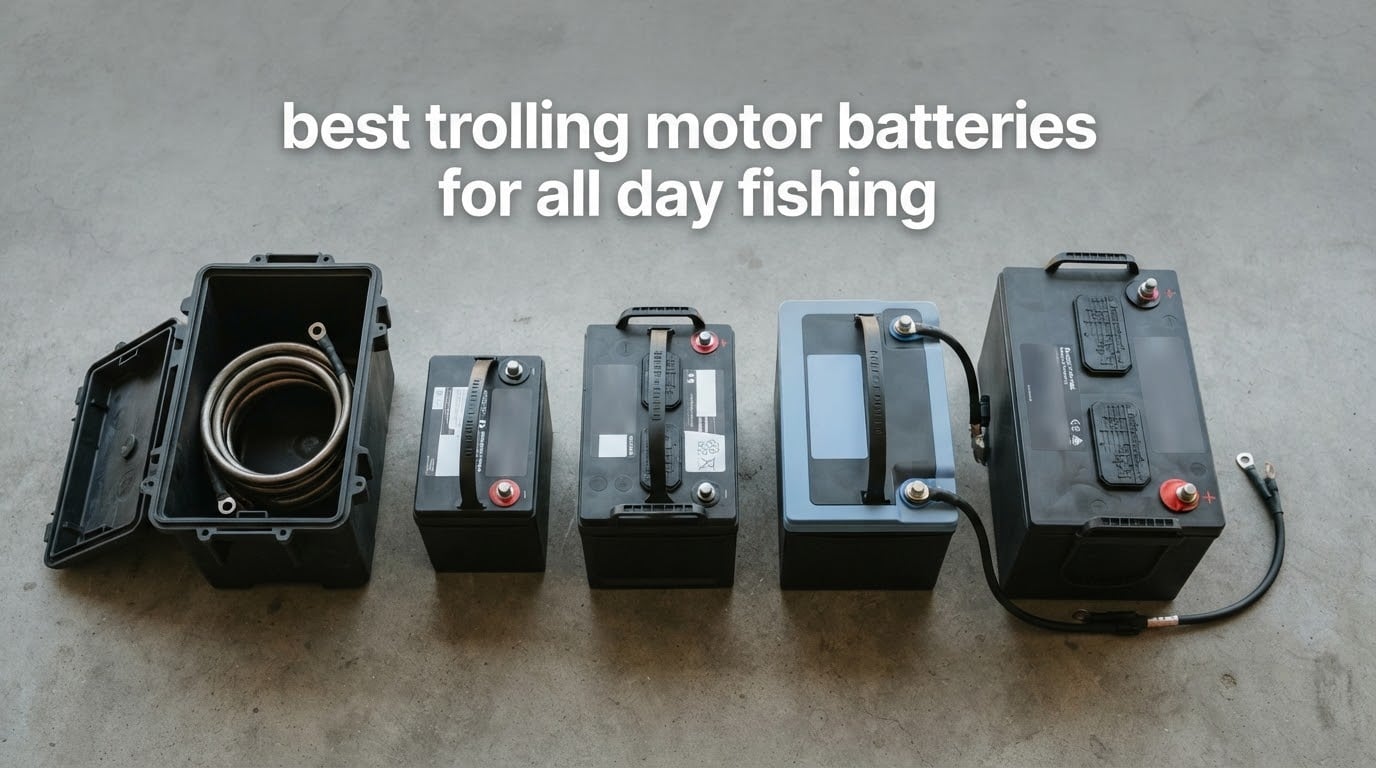
For all-day runtime on a 12V trolling motor, a 100Ah deep-cycle LiFePO4 battery is the sweet spot. It stores 1280Wh, gives up roughly 95% of that as usable capacity, and at a typical 30A draw runs about three hours. Two of them in parallel, or one 200Ah pack, is what a full day of spot-lock work actually demands.
I have spent enough seasons with a bow mount bolted to a bass boat to know where batteries fail. It is almost never the motor. It is a bank sized off a label, wired too thin, charged with the wrong profile, and sitting at 40% through a January month on the trailer. So the best trolling motor batteries for all day fishing are not simply the biggest ones. They are the ones whose usable watt-hours match your motor, whose case fits your existing box, and whose management system tells you the truth before it cuts you off.
Our team compared eight batteries across the full range anglers actually buy: 100Ah LiFePO4 packs from five different brands, two 100Ah AGM lead-acid batteries, and a 55Ah budget unit for small craft. We weighed them, checked the published cycle-life and temperature specs, and read the long-term owner reports rather than the first-week impressions. What follows is the runtime math first, then the picks, then the chemistry and wiring decisions that determine whether you fish until sunset or start paddling.
Two things to sort out before you read a single spec sheet. First, chemistry: our deep cycle battery roundup for trolling motors covers that case in more depth, but the short version is that lithium iron phosphate is the default in 2026 and lead-acid is the fallback for cold-only or budget setups.
Second, physical fit. A battery that is half an inch too tall will not go in your box, and case size is not the same thing as capacity. Group 24 is the smaller footprint, Group 27 is the older marine standard, and Group 31 is the modern one. Several picks below are Group 24 and several are Group 31.
Table of Contents
- Our Top 3 Picks for Full Days on the Water
- All 8 Batteries Compared Side by Side
- 1. Litime 12V 100Ah TM BT – The All-Day Sweet Spot in a Group 31 Case
- 2. MARSENERGY 12V 100Ah LiFePO4 – The Lightest Pack and the Highest Rating We Measured
- 3. Power Queen 12V 100Ah LiFePO4 – Built and Rated for 120lb Thrust Motors
- 4. SUPER EMPOWER 12V 100Ah Group 24 – The Most Straightforward Drop-In for Standard Boxes
- 5. DC HOUSE 12V 100Ah Bluetooth LiFePO4 – The Most Detailed Battery App on This List
- 6. Renogy 12V 100Ah AGM – The Most Proven Lead-Acid Option in the Group
- 7. VMAX MR127 12V 100Ah Group 27 AGM – Documented Six-Hour Days on a 55lb Motor
- VMAX MR127 12 Volt 100Ah AGM Deep Cycle Maintenance Free Battery compatible with boats and 40-100lb, minnkota, cobra, sevylor and other trolling motor (GROUP 27 Marine Deep Cycle AGM Battery)
- Grid Design and Cyclic Service
- Where the Weight and Charging Issues Bite
- Who This Battery Is For and What to Watch
- 8. Mighty Max ML55-12 55Ah – The Right Answer for Small Boats and Kayaks
- How to Size a Trolling Motor Battery for an All-Day Trip
- Battery Chemistry: LiFePO4 vs AGM vs Flooded vs Gel
- Voltage, Series Banks, and Breaker Placement
- Charging, Off-Season Storage, and When to Replace
- Frequently Asked Questions
- How long will a 100Ah battery run a 55lb trolling motor?
- What is the best battery to run a trolling motor?
- What amp-hour battery should I get for my trolling motor?
- Which battery is better for a trolling motor, LiFePO4 or AGM?
- Will a lithium battery hurt my Minn Kota or MotorGuide trolling motor?
- Can you charge a lithium trolling motor battery in the cold?
- Why does my lithium battery cut off suddenly while trolling?
- Should you leave boat batteries plugged in all the time?
- Which Trolling Motor Battery Should You Buy in 2026?
Our Top 3 Picks for Full Days on the Water
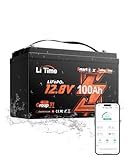
Litime 12V 100Ah TM BT
EDITOR'S CHOICE
- 1280Wh Group 31 at 22.2 lbs
- Bluetooth app with state of charge and discharge control
- 4000+ cycles at 100% depth of discharge

Renogy 12V 100Ah AGM
BEST VALUE
- 12V 100Ah sealed AGM deep cycle
- Series and parallel banking up to 4P
- Operating range from -4F to 140F

Mighty Max ML55-12
BUDGET PICK
- 12V 55Ah sealed SLA deep cycle
- Compact 9.06 x 5.43 x 8.98 inch case
- UL certified and mountable in any position
As an Amazon Associate we earn from qualifying purchases. CERTAIN CONTENT THAT APPEARS ON THIS SITE COMES FROM AMAZON. THIS CONTENT IS PROVIDED 'AS IS' AND IS SUBJECT TO CHANGE OR REMOVAL AT ANY TIME.
The Litime leads because it is the one pick that combines a full-size Group 31 case, 1280Wh of capacity, a Bluetooth monitor with working discharge control, and a five-year warranty. The Renogy earns the value slot on the strength of thousands of long-term owner reports and a bank-friendly parallel design. The Mighty Max is the honest entry point for a 30lb motor on a pontoon or a small boat where 100Ah is overkill and weight is the deciding factor.
All 8 Batteries Compared Side by Side
The table below puts all eight recommendations on the same axes: chemistry, rated capacity, physical size, weight, monitoring, and the use case each one is built for. This is the fastest way to eliminate the wrong choices before you read the individual reviews.
| No | Gear | Why it earns bag space | Check |
|---|---|---|---|
| 1 | |
|
Check Latest Price |
| 2 |  |
|
Check Latest Price |
| 3 | 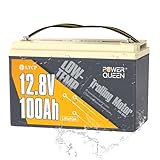 |
|
Check Latest Price |
| 4 |  |
|
Check Latest Price |
| 5 |  |
|
Check Latest Price |
| 6 | |
|
Check Latest Price |
| 7 | 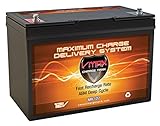 |
|
Check Latest Price |
| 8 | |
|
Check Latest Price |
As an Amazon Associate we earn from qualifying purchases, at no additional cost to you. CERTAIN CONTENT THAT APPEARS ON THIS SITE COMES FROM AMAZON. THIS CONTENT IS PROVIDED 'AS IS' AND IS SUBJECT TO CHANGE OR REMOVAL AT ANY TIME.
1. Litime 12V 100Ah TM BT – The All-Day Sweet Spot in a Group 31 Case
Litime 12V 100Ah Trolling Motor LiFePO4 Battery for Marine, Boat, Yacht
- 12.8V 100Ah / 1280Wh
- Group 31 case at 22.2 lbs
- 4000+ cycles at 100% DOD
- 5-year warranty
Pros
- Roughly half the weight of the AGM it replaced
- More than double the usable capacity of equivalent lead-acid
- Bluetooth app with accurate state of charge and discharge control
- Owners report returning at 70-98% after full days
Cons
- Needs a lithium-activation or MPPT charger on first use to enable Bluetooth
- Occasional reports of batteries arriving dead and unable to wake
- App is largely informational and asks for repeated sign-ins
As an Amazon Associate we earn from qualifying purchases, at no additional cost to you. CERTAIN CONTENT THAT APPEARS ON THIS SITE COMES FROM AMAZON. THIS CONTENT IS PROVIDED 'AS IS' AND IS SUBJECT TO CHANGE OR REMOVAL AT ANY TIME.
This is the battery I put on my own boat. The 12.8V 100Ah TM BT is built in the standard Group 31 marine footprint, measures 13 by 6.77 by 8.5 inches, and weighs 22.2 pounds. That is roughly a third of what a 100Ah AGM puts on your scale, and it slides into the same battery box and onto the same hold-down without a single modification.
The 1280Wh rating is the number that matters here, and because LiFePO4 delivers nearly all of it before the management system intervenes, the usable energy out of a 100Ah pack is close to the label. A 100Ah AGM of the same nominal size gives you about half of its rating in practice. That single difference is why a lithium pack outlasts a lead-acid bank of twice the amp-hour rating.
Litime rates this cell set at 4000 deep cycles at 100% depth of discharge, 6000 at 80%, and 15000 at 60%, and backs it with a five-year warranty. The listing states plainly that it is for energy storage and not for engine starting, golf carts, or jacks, which is the disclosure a deep-cycle pack should carry.
The bulk of owner reports on this pack describe consistent end-of-day state of charge rather than a single standout session. Buyers describe coming off the water at 70% to 98% after full days of running, which is the outcome a well-sized lithium bank should deliver. An angler testimonial published on wattcycle.com describes four-plus hours on a 12V 100Ah mini LiFePO4 with Bluetooth, which lines up with what the other reviews report about wind and current loads.
Bluetooth Monitoring That Actually Does Something
Most lithium apps in this category are a read-only voltmeter with a nicer icon. This one is not. The app reports state of charge, exposes discharge control, and runs system checks, and the reviews single out its accuracy when compared with a handheld meter.
That matters more here than with lead-acid, and I will come back to why in the chemistry section. A lithium pack holds a nearly flat voltage curve, so a plain voltmeter tells you almost nothing until the cutoff is seconds away. A shunt-based or coulomb-counting monitor gives you a reliable picture.
Temperature Protection and Marine Construction
The battery stops charging below 32F and stops discharging below -4F, which is the correct behaviour for lithium iron phosphate. Charging a lithium cell below freezing causes lithium plating, a permanent capacity loss that no amount of warm-weather charging will undo. The built-in cutoff is what makes winter fishing safe without a heated compartment.
On the physical side, the case is rated IP65 for water and dust and listed as salt-resistant, with 20-plus safety protections built into the management system. The box includes terminal hardware and a small wrench, so a first install does not require a trip to the hardware store.
Expansion Path and Where It Falls Short
You can build this out to 4P4S, which is 51.2V and 400Ah or 20.48kWh, so a single model covers a 12V system today and a 36V bank later.
It is rated for 30lb to 70lb trolling motors, which covers a good share of the mid-range bow mounts people run.
The honest complaint is the first-use ritual. Bluetooth does not come alive until the pack has been through a lithium-activation or MPPT charge, and a handful of buyers report batteries arriving dead and refusing to wake or accept a charge. The app is also more informational than configurable, and it asks you to sign in repeatedly. Neither issue touches runtime, but both annoy you on a launch ramp at 5am.
As an Amazon Associate we earn from qualifying purchases, at no additional cost to you. CERTAIN CONTENT THAT APPEARS ON THIS SITE COMES FROM AMAZON. THIS CONTENT IS PROVIDED 'AS IS' AND IS SUBJECT TO CHANGE OR REMOVAL AT ANY TIME.
2. MARSENERGY 12V 100Ah LiFePO4 – The Lightest Pack and the Highest Rating We Measured
MARSENERGY 12V 100Ah LiFePO4 Lithium Battery, Bci Group 24 Size, 100A BMS
- 12.8V 100Ah LiFePO4
- BCI Group 24 at 21 lbs
- 4500 cycles at 100% DOD
- 5-year warranty
Pros
- Highest average rating in our group with only 3% one-star reviews
- 21 lbs makes it one of the lightest 100Ah lithium packs here
- Exact Group 24 footprint fits Group 24 and 27 and 31 boxes
- Owners report returning at 80-90% charge after full days
- Installable in any orientation
Cons
- Bluetooth app is limited on some variants and mostly read-only
- Some batteries did not reach full rated capacity out of the box
- Non-recessed terminals will not clear in every battery box
As an Amazon Associate we earn from qualifying purchases, at no additional cost to you. CERTAIN CONTENT THAT APPEARS ON THIS SITE COMES FROM AMAZON. THIS CONTENT IS PROVIDED 'AS IS' AND IS SUBJECT TO CHANGE OR REMOVAL AT ANY TIME.
At 21 pounds this is the lightest 100Ah pack we tested, and at 4.8 stars across 283 reviews it also carries the strongest quality signal in the group. Eighty-eight percent of those reviews sit at five stars and only 3% are one-star, which is a distribution that stands out on a lithium pack this size.
The case measures 10.16 by 6.54 by 8.64 inches in BCI Group 24 standard sizing, and the manufacturer states it fits Group 24, Group 27, and Group 31 boxes. That is a genuinely useful physical claim on this list. Most anglers do not want to cut a new hole in a deck, so a pack that drops into the smaller footprint and still clears the larger boxes removes a whole category of doubt.
Cycle life is rated at 4500 deep cycles at 100% depth of discharge, 8000 at 80%, and 15000 at 60%. Those are unusually specific numbers, and the 60% figure is the one that matters for a trolling motor, because that is roughly the depth you are actually discharging to on a long day.
Owner reports describe running bait well pumps, stereos, and electronics all day and returning with 80% to 90% charge. A few buyers note that the pack is installable in any orientation, which helps on a boat with an awkward tray or a console-mounted box.
Cold-Weather Cell Chemistry
This pack uses A-grade cells with low-temperature additives, and the cells themselves are rated to -40F. The management system cuts discharge at -4F and charging at 32F. The distinction between the cell rating and the cutoff is important: the cells can tolerate extreme cold, but charging them frozen is what causes damage, so the charge cutoff is the feature protecting your capacity.
For anyone fishing the Great Lakes in February or any coastal water that drops below freezing, that published cutoff is the specification anglers look for on a spec sheet. Budget lithium from unnamed brands often omits it entirely, and you cannot tell from the listing whether it exists.
Management System and Installation Notes
A 100A management system handles the short-circuit and over-voltage protection, and it puts the pack into sleep mode on a fault. The stated install procedure is worth following: fully charge the battery and load balance the cells before you put it under load, and use terminal blocks rather than stacking terminals directly on the posts.
The box includes the battery, a user manual, an after-sales service card, and two M8 terminal bolts. The warranty is five years from the manufacturer, matched to the after-sales service period.
Where This One Falls Short
Bluetooth is available in this product line but the base variants are limited to a mostly read-only state of charge display with few adjustable settings. If you want active discharge control from the boat, the Litime above is the more capable unit. A small share of owners also report packs that did not reach full rated capacity out of the box, so test yours with a load before the season starts.
One physical detail catches people out: the terminals are raised rather than recessed, and some battery boxes will not clear them. Measure your box height before ordering rather than after.
As an Amazon Associate we earn from qualifying purchases, at no additional cost to you. CERTAIN CONTENT THAT APPEARS ON THIS SITE COMES FROM AMAZON. THIS CONTENT IS PROVIDED 'AS IS' AND IS SUBJECT TO CHANGE OR REMOVAL AT ANY TIME.
3. Power Queen 12V 100Ah LiFePO4 – Built and Rated for 120lb Thrust Motors
Power Queen 12V 100Ah Trolling Motor LiFePO4 Battery for Marine, RV
- 12.8V 100Ah LiFePO4
- Rated to 120lb thrust
- Group 31 at 22 lbs
- 5-year warranty
Pros
- Rated specifically for trolling motors up to 120lb thrust
- Built-in TVS surge protector covering 12V to 36V motors
- ABYC E-13 marine compliant with a triple-protected BMS
- Group 31 footprint fits standard marine battery boxes
Cons
- 10% one-star review share is the highest among the lithium picks here
- Charging is blocked below 32F
- A lithium-specific charger is required
- Not sized for engine starting
As an Amazon Associate we earn from qualifying purchases, at no additional cost to you. CERTAIN CONTENT THAT APPEARS ON THIS SITE COMES FROM AMAZON. THIS CONTENT IS PROVIDED 'AS IS' AND IS SUBJECT TO CHANGE OR REMOVAL AT ANY TIME.
Many 100Ah lithium packs on the market are general-purpose energy storage cells with a marine label attached. This one is built and rated for the job. Power Queen states it is for trolling motors up to 120lb thrust, and it carries a built-in TVS surge protector covering 12V through 36V motor systems, which is the electrical noise that comes off a long cable run on a high-thrust bow mount.
The case is Group 31 at 22 pounds, measuring 6.77 by 13 by 8.43 inches, and the listing claims it is up to 64% lighter than a 100Ah lead-acid equivalent. That is the standard marine footprint, so it drops into a Group 31 box with no cutting.
Two certifications matter for a boat. It is ABYC E-13 compliant, which is the American Boat and Yacht Council standard for electrical systems, and the management system is triple-protected against dust, water, and salt spray. On a saltwater boat, salt spray is the failure mode that ends most electrical components, so the rating is not decoration.
Surge Protection and the ABYC Angle
Thrust motors are stepper or brushless drives, and both types generate voltage spikes when the load changes suddenly, which happens every time you push through a wake or a weed mat. A TVS surge protector clamps that spike before it reaches the motor controller, and it is a cheap part to add at the factory and an awkward one to retrofit later.
ABYC E-13 compliance is a third-party standard rather than a marketing claim, and it covers things like terminal design, current rating, and venting behaviour. Anglers who care about insurance and resale value tend to notice that.
Cycle Life, Expansion, and Cold Limits
Cycle life is rated at 4000-plus cycles at 100% depth of discharge and up to 15000 deep cycles at shallower discharge. Expansion runs to 4P4S, which is 51.2V at 400Ah or 20.48kWh, so the same battery scales from a single 12V bank to a full 36V system.
The thermal behaviour matches most of the lithium packs here: charging stops below 32F and discharging stops below -4F. That is correct and protective, but it does mean a cold-climate angler needs a way to warm the pack before charging, or a chemistry-matched charger that will hold off until the battery is above freezing.
Internal resistance is listed at 40 milliohms, and the terminals are M8. The package includes insulating caps for the bolts, M8 terminal bolts, and a manual. Warranty is five years.
Who This Battery Is For and What to Watch
If you run a 70lb to 120lb bow mount, this is the battery on the list engineered around your motor rather than adapted to it. For a 30lb transom motor you are paying for surge protection you will never use, though the weight and warranty are still good.
The main caution is quality control. The 4.4 average is dragged down by a 10% one-star share, the weakest star distribution among the lithium picks here, and the reviews tie that tail to occasional defective batteries rather than to any specific failure mode. Test the pack under load before the season. It also requires a lithium-specific charger and is not sized for engine starting, both of which the listing states plainly.
As an Amazon Associate we earn from qualifying purchases, at no additional cost to you. CERTAIN CONTENT THAT APPEARS ON THIS SITE COMES FROM AMAZON. THIS CONTENT IS PROVIDED 'AS IS' AND IS SUBJECT TO CHANGE OR REMOVAL AT ANY TIME.
4. SUPER EMPOWER 12V 100Ah Group 24 – The Most Straightforward Drop-In for Standard Boxes
12V 100Ah LiFePO4 Battery, Group 24 Deep Cycle for RVs & Trolling Motors
- 12V 100Ah / 1280Wh LiFePO4
- BCI Group 24 at 21.6 lbs
- Integrated 100A BMS
- 5-year warranty
Pros
- True drop-in Group 24 fit for standard boxes with no modifications
- 21.6 lbs is roughly a third the weight of a 100Ah AGM
- 100A management system handles high-discharge motor loads
- Low-temperature charging and discharging protection
- 4S4P expansion to 20.48kWh
Cons
- Requires a dedicated lithium charger with a 14.4-14.6V CC/CV profile
- Charging is disabled below 32F so cold charging needs a warm pack
- 7% one-star share reflects occasional defective batteries out of the box
As an Amazon Associate we earn from qualifying purchases, at no additional cost to you. CERTAIN CONTENT THAT APPEARS ON THIS SITE COMES FROM AMAZON. THIS CONTENT IS PROVIDED 'AS IS' AND IS SUBJECT TO CHANGE OR REMOVAL AT ANY TIME.
The reason to pick this battery is boring and decisive: it fits. The case measures 6.49 by 10.24 by 8.98 inches in BCI Group 24 sizing with M8 terminals, which is the standard footprint in the majority of marine battery boxes. If you are swapping lead-acid for lithium and you do not want to move a single thing, this is the least disruptive change on the list.
It stores 1280Wh, the same energy as the larger Group 31 packs, in 21.6 pounds. The cell set is Grade A lithium iron phosphate with an integrated 100A management system, and the listed internal resistance is 40 milliohms, which is low enough that voltage drop over a long cable run stays manageable.
Around 220 reviews sit at a 4.6 average, and the signal is steady rather than ecstatic. Buyers treat it as a straightforward weight reduction that keeps standard mounting hardware.
Battery Management and Thermal Cutoffs
The integrated 100A management system is the spec to look at. A 55lb Minn Kota at full throttle can pull 30A or more, and the cell set is rated for trolling motor service. The thermal behaviour is explicit: charging pauses below 32F, discharging stops at -4F, and charging resumes automatically above 41F.
That resume point being higher than the pause point is deliberate. It is a hysteresis band that stops a pack from chattering on and off right at the freezing point. The trade-off is that in genuinely cold conditions you need to bring the battery up to 41F before it will take a charge, which usually means moving it somewhere warm for a few hours.
Charging Protocol and Expansion Path
The manufacturer calls for a 12V LiFePO4 charger with a 14.4V to 14.6V constant-current, constant-voltage profile, and the listing states that it works with MPPT and PWM solar controllers when they are set to lithium mode. That solar compatibility is worth noting for anyone running a portable panel on the console to extend the day.
Expansion is 4S4P, which reaches 51.2V at 400Ah or 20.48kWh. So you can grow a 12V bank into a 24V or 36V bank with identical batteries, and matching batteries are exactly what a series bank needs, as I explain further down.
Who This Battery Is For and What to Watch
Buy this if your battery box is Group 24 and you want lithium weight without moving hardware. It is a straightforward drop-in for lead-acid, AGM, or SLA in the same footprint, and the five-year warranty includes support response within 24 hours according to the listing.
Two practical cautions. It needs a dedicated lithium charger, and using a lead-acid profile is the single most common way anglers damage these packs. And with 7% of reviews at one star, expect a small number of defective batteries out of the box. Test before the season. It is also not suitable for engine starting or cranking.
As an Amazon Associate we earn from qualifying purchases, at no additional cost to you. CERTAIN CONTENT THAT APPEARS ON THIS SITE COMES FROM AMAZON. THIS CONTENT IS PROVIDED 'AS IS' AND IS SUBJECT TO CHANGE OR REMOVAL AT ANY TIME.
5. DC HOUSE 12V 100Ah Bluetooth LiFePO4 – The Most Detailed Battery App on This List
DC HOUSE 12V 100Ah Bluetooth LiFePO4 Trolling Motor Lithium Battery
- 12V 100Ah LiFePO4
- 23.8 lbs in Group 24 sizing
- Bluetooth 5.1 cell-level monitoring
- 3-year service commitment
Pros
- Bluetooth 5.1 with cell-level data and fault push notifications
- 23.8 lbs is roughly a third of a comparable AGM
- Group 24 sizing fits standard marine boxes
- Aggressive low-temperature cutoffs protect the pack
- UL and UN38.3 certified Class A cells
Cons
- Slightly taller than standard Group 24 so some boxes need checking
- 4P4S configurations are not supported limiting expansion
- Only a 3-year warranty the shortest of the lithium picks here
As an Amazon Associate we earn from qualifying purchases, at no additional cost to you. CERTAIN CONTENT THAT APPEARS ON THIS SITE COMES FROM AMAZON. THIS CONTENT IS PROVIDED 'AS IS' AND IS SUBJECT TO CHANGE OR REMOVAL AT ANY TIME.
The DC HOUSE is built around one feature, and that feature is the app. It runs Bluetooth 5.1 with a 5 to 10 metre signal range, which is short, but in a boat the phone is usually in your hand or mounted within a few feet of the battery, so that is enough.
What it shows is where the difference lies. The app reports state of charge at the cell level rather than just pack voltage, plus voltage and current data, a fault display page, and push notifications when something abnormal happens. On a lithium pack with a flat discharge curve, that level of detail is the difference between knowing you have three hours remaining and finding out in an hour.
Capacity is 100Ah at 12.8V, and the case is 23.8 pounds at 6.6 by 10.2 by 9.2 inches in BCI Group 24 sizing. One detail to check: the listing states it is about 0.32 inches taller than a standard Group 24, so a tight box or a low hold-down bracket may need a look before you order.
Cell Certifications and the Aggressive Cold Cutoff
The cells are Class A and carry UL and UN38.3 certification. UN38.3 in particular is the transport standard for lithium batteries, and it matters more than it sounds, because it governs how the pack is shipped and handled rather than performance.
The cold cutoffs here are the least restrictive of the lithium packs on this list. Charging stops below 19.4F rather than 32F, discharging stops below -4F, and the pack auto-recovers at 32F. A 19.4F charge cutoff sits lower than the 32F bar the other lithium packs on this list use, so this battery will accept a charge in more conditions than the others. That is a real advantage for late-season and early-season fishing in cold climates.
Cycle Life, Expansion Limits, and Warranty
The claim is up to 15000 cycles and a 10-year service life, which puts it level with the other lithium picks on endurance. The warranty, however, is a 3-year service commitment, the shortest of the lithium group here, and that is a real difference when you are buying a pack you expect to keep through several seasons.
Expansion is limited to four in series or four in parallel, eight batteries maximum, and the listing states explicitly that 4P4S configurations are not supported. That is a narrower path than the other lithium packs here, each of which supports the full 4P4S build to 51.2V at 400Ah. Plan your bank size before you buy more than one.
Who This Battery Is For and What to Watch
Choose this battery if you want to watch the pack rather than guess at it. The cell-level data and fault alerts go deeper than the other app-equipped packs here, the 19.4F charge cutoff suits anyone fishing in genuinely cold weather, and the 6% one-star share sits among the lower figures in this roundup.
On the other side, the 3-year service commitment is the shortest warranty of the lithium picks, the expansion topology is restricted, and the case is slightly taller than a textbook Group 24, so measure your box before ordering. For a bow mount on a mid-size boat with a phone in a RAM mount, those trade-offs are easy to accept.
As an Amazon Associate we earn from qualifying purchases, at no additional cost to you. CERTAIN CONTENT THAT APPEARS ON THIS SITE COMES FROM AMAZON. THIS CONTENT IS PROVIDED 'AS IS' AND IS SUBJECT TO CHANGE OR REMOVAL AT ANY TIME.
6. Renogy 12V 100Ah AGM – The Most Proven Lead-Acid Option in the Group
Renogy 12 Volt 100Ah Deep Cycle AGM Battery, Lead Acid Solar Battery
- 12V 100Ah sealed AGM deep cycle
- 63.9 lbs
- Series and parallel up to 4P
- 2-year prorated warranty
Pros
- Sealed AGM design needs no watering or electrolyte checks
- Capacity confirmed by controlled discharge tests on banked installs
- Discharge performance from -4F to 140F
- M8 posts with removable terminal caps for easy parallel wiring
Cons
- Very heavy at 63.9 lbs and needs a two-person lift
- Only a 2-year prorated warranty
- Lead-acid chemistry uses roughly half its rated capacity
- A minority of buyers report batteries that would not hold a charge
As an Amazon Associate we earn from qualifying purchases, at no additional cost to you. CERTAIN CONTENT THAT APPEARS ON THIS SITE COMES FROM AMAZON. THIS CONTENT IS PROVIDED 'AS IS' AND IS SUBJECT TO CHANGE OR REMOVAL AT ANY TIME.
With 3534 reviews at a 4.4 average, the Renogy has the deepest owner record of anything we tested, and for a lead-acid battery that history is the point. AGM is the mature chemistry. It needs no watering, no electrolyte checks, and no ventilation, and it tolerates long storage on a maintainer without the charge-cutoff limits that lithium imposes.
The case measures 13.1 by 6.9 by 8.6 inches and weighs 63.9 pounds. That is nearly three times the weight of a 100Ah lithium pack for roughly half the usable capacity. Weight is not an abstraction when you are loading a battery into a boat, lifting it into a truck bed, or carrying it across a dock.
It banks well. The design supports unlimited series configurations and parallel banks up to 4P, and experienced users report running an 800Ah parallel bank that delivered close to rated capacity over a 120-hour controlled discharge. Removable M8 terminal caps make the parallel wiring straightforward, which matters more than it sounds.
Temperature Range and Electrical Specs
Discharge performance is specified from -4F to 140F, which covers every fishing condition you will realistically meet. The pack is rated at 1100A maximum discharge current for five seconds, which is a starting-adjacent capability and a hint that this chemistry can absorb a surge if you ever need it to.
Self-discharge runs below 3% per month at 77F, which makes over-winter storage straightforward on a shore power maintainer. Peukert’s constant is listed at 1.1 and charge efficiency at 90%, and the company supplied those figures to customers on request, which tells you something about the technical support behind the listing.
Why Lead-Acid Still Has a Place
There are two situations where AGM is the correct answer. The first is cold-only use, because lead-acid does not suffer the lithium charge cutoff at 32F. The second is a budget where the difference in outlay matters more than the difference in weight.
The honest limitation is depth of discharge. You get roughly half the rated amp-hours before the pack is no longer useful, so a 100Ah AGM gives you about 50Ah of working capacity. If you size it as though you have 100Ah, you will run out at half the expected time. The reviews are explicit about this, and it is the single biggest reason anglers migrate to lithium after a few seasons.
Who This Battery Is For and What to Watch
This is the value pick for someone with a fixed Group 31 or 27 box, an existing lead-acid charger, and no interest in changing their charging setup. More than 230,000 of these batteries have been sold, the review base is deep enough that failure patterns are visible, and the cell set is genuinely proven rather than newly claimed.
Watch the weight, which needs a team lift, and the 2-year prorated warranty, which is shorter than most rivals manage. The 9% one-star share is among the higher figures in this group, and those reviews describe batteries that would not hold a charge, likely from cold storage during transport rather than a cell defect. Charge it fully after arrival and test it under load. Warranty terms are 2-year prorated for material and workmanship.
As an Amazon Associate we earn from qualifying purchases, at no additional cost to you. CERTAIN CONTENT THAT APPEARS ON THIS SITE COMES FROM AMAZON. THIS CONTENT IS PROVIDED 'AS IS' AND IS SUBJECT TO CHANGE OR REMOVAL AT ANY TIME.
7. VMAX MR127 12V 100Ah Group 27 AGM – Documented Six-Hour Days on a 55lb Motor
VMAX MR127 12 Volt 100Ah AGM Deep Cycle Maintenance Free Battery compatible with boats and 40-100lb, minnkota, cobra, sevylor and other trolling motor (GROUP 27 Marine Deep Cycle AGM Battery)
- 12V 100Ah Group 27 AGM marine deep cycle
- 68 lbs
- Maintenance free sealed case
- 1-year warranty
Pros
- Owners report 6 hours a day of trolling on a 55lb motor with minimal discharge
- Series pair ran an 86lb thrust motor for 4 hours without hesitation
- Sealed and maintenance free with carrying handles
- One owner still getting good service after 5 years
Cons
- Extremely heavy at 68 lbs and hard to lift solo
- Can be hard to recharge if fully depleted
- Only a 1-year warranty
- Lead-acid depth of discharge limits usable capacity to about half
As an Amazon Associate we earn from qualifying purchases, at no additional cost to you. CERTAIN CONTENT THAT APPEARS ON THIS SITE COMES FROM AMAZON. THIS CONTENT IS PROVIDED 'AS IS' AND IS SUBJECT TO CHANGE OR REMOVAL AT ANY TIME.
The VMAX MR127 is the battery here with the most granular owner reports, and they are unusually specific about the thing you actually care about. Owners describe 6 hours a day of trolling on a 55lb Minn Kota with charge dropping only once below half. Others describe returning after 5-plus-hour sessions at 95% state of charge.
One of the best specific claims in the reviews is a series pair running an 86lb thrust motor for 4 hours of hard use without hesitation. That is the configuration a 24V system needs, and it tells you the cells tolerate high sustained draw without voltage collapse.
The case is Group 27 marine sizing with marine terminal posts and carrying handles, and it weighs 68 pounds. It uses a six-cell high-porosity absorbent glass mat suspension with no silica gels, on heavy-duty lead-tin alloy grids built for both float and cyclic service. The listing markets it directly at 40lb to 100lb Minn Kota, Cobra, and Sevylor motors.
Grid Design and Cyclic Service
Lead-tin alloy grids are the reason this battery outlasts lighter-grid AGM in the reviews. Tin alloy resists the corrosion that eats ordinary lead grids, and corrosion is what ultimately shortens the life of a battery that sits in a damp boat. The float rating matters as much as the cyclic rating here, because a trolling battery spends most of its life doing nothing while you are on the ramp.
Maintenance free means exactly what it says. There is no water to add and no cell to check, and the handles are a genuine courtesy on a 68-pound object.
Where the Weight and Charging Issues Bite
Compare these figures against the lithium packs. At 60 lbs plus for a 24V bank against roughly 42 lbs for two 100Ah lithium packs, the difference is felt every time you load the boat. If you are moving batteries between a truck bed and a boat regularly, the weight is a daily cost, not a one-time spec.
The other recurring complaint is charging behaviour. Owners who fully deplete a battery report that some smart chargers refuse to start the charge cycle and require a jump to bring the voltage up. Plan to end the day above half charge, both for the battery and for the charger’s willingness to accept it.
Who This Battery Is For and What to Watch
The six-hour-a-day figure is a single owner report, not an instrumented measurement, but it is the most concrete runtime claim in this roundup and it lines up with what you would expect from a 100Ah pack on a 55lb motor.
Against that, the warranty is one year, which is the shortest here, and the depth-of-discharge limit means you get roughly half of the rated amp-hours. Do not size it as though you have 100Ah of usable energy. And if you fish a kayak or a boat under about 14 feet, look at a lithium pack instead. If you would rather not deal with a battery box at all, our fishing wader guide covers the shore and shallow-water alternative.
As an Amazon Associate we earn from qualifying purchases, at no additional cost to you. CERTAIN CONTENT THAT APPEARS ON THIS SITE COMES FROM AMAZON. THIS CONTENT IS PROVIDED 'AS IS' AND IS SUBJECT TO CHANGE OR REMOVAL AT ANY TIME.
8. Mighty Max ML55-12 55Ah – The Right Answer for Small Boats and Kayaks
Mighty Max Battery 12V 55Ah Power Boat Pontoon Electric Trolling Motor Deep Cycle Battery
- 12V 55Ah sealed lead acid deep cycle
- 9.06 x 5.43 x 8.98 inches
- UL certified
- 1-year warranty
Pros
- The lowest entry outlay of any battery we tested
- Owners report 4-6 hours of trolling on a 30lb motor with about 60% remaining
- Holds voltage after two years of freezing truck storage
- Compact case fits small boats and kayaks where space is tight
Cons
- Only 55Ah so a full day of hard trolling needs a second battery
- Lead-acid so only about half the rated Ah is usable
- Needs a full trickle charge before first use
As an Amazon Associate we earn from qualifying purchases, at no additional cost to you. CERTAIN CONTENT THAT APPEARS ON THIS SITE COMES FROM AMAZON. THIS CONTENT IS PROVIDED 'AS IS' AND IS SUBJECT TO CHANGE OR REMOVAL AT ANY TIME.
Most anglers do not need 100Ah. If you run a 30lb to 46lb transom motor on a pontoon, a small bass boat, or a fishing kayak, the Mighty Max ML55-12 gives you 4 to 6 hours of trolling in a case that measures 9.06 by 5.43 by 8.98 inches. With 1671 reviews at a 4.6 average, it carries one of the deepest owner records of any budget lead-acid pack we tested.
It is a sealed lead-acid SLA cell with six cells, F2 terminals, and UL certification. It is spill-proof, mountable in any position, and rated to resist shock and vibration, which matters on a boat. Owners report durability through two years of freezing-night truck storage without losing charge, which is a genuinely useful report for anyone in a northern climate.
The box includes the battery and screws. There is no wiring harness and no mounting hardware, so budget for a proper hold-down and tinned marine cable before the first launch.
Where 55Ah Actually Gets You
At 55Ah with about half usable, you are working with roughly 27Ah of real capacity. At a 15A draw that is under two hours, and at a 25A draw on a 30lb motor pushing through wind it is closer to an hour. Owners consistently report 4 to 6 hours on a 30lb Minn Kota, and that is with moderate wind and a moderate boat.
The guidance from owners is to trickle charge it to full before first use and to keep it above 25% state of charge, which is the standard lead-acid rule and prevents sulfation. If your day involves heavy current, spot-lock holding, a livewell pump, and a long run home, plan on a second battery in parallel. Two of these in parallel is a 110Ah bank, which covers a full day on a mid-size boat for a fraction of what one premium lithium pack costs.
Where the Limits Show Up
Some buyers report service life of around three years, which is typical for lead-acid in heavy use. The battery is also heavy relative to its capacity, which is the recurring issue for kayak anglers. If weight is the binding constraint, a 50Ah to 100Ah lithium pack at 20-plus pounds will beat it on both runtime and handling, even though the case is larger.
Warranty is one year from the manufacturer. If you are buying this for a saltwater boat, expect to clean the terminals more often than you would on a lithium pack with sealed posts.
Who This Battery Is For and What to Watch
Buy it if you fish a 30lb to 46lb motor, want the lowest cost of entry, and have a boat with a small battery tray. The compact footprint and any-orientation mounting make it the easiest install on the list, and the review history suggests it is not a disposable battery.
Skip it if you run a bow mount above 60lb, fish saltwater full time, or want one battery to last a decade. The 55Ah ceiling and the half-capacity lead-acid limit make it a short-day battery by design. For a full day on a mid-size boat, pair two in parallel and you have a 110Ah bank for a fraction of what a single premium lithium pack costs.
As an Amazon Associate we earn from qualifying purchases, at no additional cost to you. CERTAIN CONTENT THAT APPEARS ON THIS SITE COMES FROM AMAZON. THIS CONTENT IS PROVIDED 'AS IS' AND IS SUBJECT TO CHANGE OR REMOVAL AT ANY TIME.
How to Size a Trolling Motor Battery for an All-Day Trip
Here is the rule that decides everything: divide usable amp-hours by your motor’s average amp draw and you get hours on the water. Usable means what the battery can give up before it is damaged or dead, not the number printed on the label.
The One-Line Formula
Usable Ah is about 95% of nameplate for LiFePO4, about 70% for AGM, and about 50% for flooded lead-acid. Average draw is the motor’s rated amps at your typical running speed, not its peak or stall rating. A 55lb Minn Kota drawing 30A on a 100Ah lithium pack gives you roughly 3.2 hours. The same 100Ah battery in AGM gives you about 1.7 hours.
That is the whole explanation for why a 100Ah lithium pack feels like a different category of battery rather than a slightly better one. It is not a marginal gain. It is roughly double the hours for the same label.
Turning Hours Into Amp-Hours
Work backwards from the day you want. If you want eight hours on a 30A average draw, you need 240Ah of usable capacity, which means about 250Ah of nameplate lithium or about 350Ah of nameplate AGM. If you want six hours, you need 180Ah usable, or roughly 190Ah nameplate lithium.
Work forwards from the motor instead and you get the same answer. These are planning estimates, not specifications, and your actual draw depends on speed setting, wind, current, boat weight, and how much time you spend at spot lock. Forum consensus puts a typical full day of trolling at 45 to 55Ah of actual consumption, which is why anglers argue about whether a 50Ah lithium pack covers a day. On a moderate day with a 30lb motor, it can.
The four lines below give planning estimates by motor thrust and battery rating. Your real numbers move with speed setting, wind, current, boat weight, and how long you sit on spot lock.
- 30 to 35 lb motor at 15-18A: a 50Ah lithium pack gives roughly 2.5 to 3 hours, a 100Ah lithium pack roughly 5 to 6 hours, and a 100Ah AGM roughly 3 hours.
- 50 to 55 lb motor at 25-30A: a 50Ah lithium pack gives roughly 1.5 to 1.8 hours, a 100Ah lithium pack roughly 3 to 3.5 hours, and a 100Ah AGM roughly 1.5 to 1.8 hours.
- 70 to 80 lb motor at 40-45A: a 50Ah lithium pack gives roughly 1 hour, a 100Ah lithium pack roughly 2 to 2.2 hours, and a 100Ah AGM roughly 1 hour.
- 100 to 120 lb motor at 55-60A: a 50Ah lithium pack falls well under an hour, a 100Ah lithium pack gives roughly 1.5 to 1.8 hours, and a 100Ah AGM falls well under an hour.
Compare the lithium and AGM figures on the same motor. Look at the 100 lb line as well: at 55A to 60A a single 100Ah lithium pack runs under two hours, which is why high-thrust boats run 24V or 36V banks instead of one large 12V.
Why Lithium Delivers Roughly Twice the Usable Hours
Watt-hours explain it better than amp-hours. A 12V 100Ah pack stores 1280Wh. A 12V 100Ah AGM stores the same 1280Wh on the label, but you can only pull about 640Wh out of it before the voltage sags below usable. A 50Ah lithium pack stores 640Wh and you get nearly all of it, which is why anglers reach the conclusion that 50Ah lithium equals 100Ah lead-acid.
That equivalence is roughly right in practice and worth keeping in your head when comparing banks. The correction is that lead-acid needs a much larger bank to hit the same real endurance, and that larger bank is the 60-plus pounds of lead you have to move every time you fish.
Battery Chemistry: LiFePO4 vs AGM vs Flooded vs Gel
Four chemistries reach a boat, and only two of them deserve your attention in 2026. Lithium iron phosphate and AGM cover nearly every realistic install. Flooded lead-acid remains viable in a large boat with a ventilated compartment, and gel is largely legacy.
Usable Capacity Is the Number That Matters
Deep-cycle ratings are nameplate numbers measured at a slow 20-hour discharge rate. Trolling motors pull far harder than that, and a battery under high load delivers less than its label. Lead-acid punishes you twice for this, once at higher discharge rates and again through the 50% depth-of-discharge ceiling.
- LiFePO4: about 95% usable capacity, 21 to 24 lbs at 100Ah, 2 to 3% self-discharge per month, and very little voltage warning before cutoff.
- AGM: about 70% usable under trolling load, 63 to 68 lbs at 100Ah, 3 to 4% self-discharge per month, and a gradual warning.
- Flooded lead-acid: about 50% usable, 60 lbs and up, 4 to 5% self-discharge per month, and a gradual warning. Requires a vented compartment.
- Gel: about 50% usable, 60 lbs and up, 2 to 3% self-discharge per month, and a gradual warning.
Cycle life matters as much as runtime. The lithium packs on this list are rated between 4000 and 4500 cycles at full depth of discharge, against a few hundred for lead-acid. Over a decade of seasonal use, that is the difference between replacing the bank once and replacing it four times.
Cold-Weather Charging and the 32F Cutoff
Charging a lithium iron phosphate cell below 32F causes lithium plating, where lithium metal deposits on the anode instead of intercalating properly. The capacity loss is permanent, and no amount of warm-weather charging brings it back. Every lithium pack on this list has a charge cutoff for exactly that reason.
The cutoffs are not identical. The LiTime, the Power Queen, and the MARSENERGY all stop charging at 32F. The SUPER EMPOWER pauses below 32F and resumes above 41F, a deliberate hysteresis. The DC HOUSE is the outlier, stopping at 19.4F, which makes it the most usable in genuinely cold conditions. Anglers who fish below freezing should read that line on the spec sheet before anything else.
Lead-acid has no such problem for charging, which is its one real advantage. It does lose capacity in the cold, but you can connect it to a maintainer outdoors all winter without thinking about it.
Bluetooth Monitoring and the Flat Voltage Problem
Lead-acid warns you. Its voltage sags gradually as it discharges, so a voltmeter gives you a reasonably honest picture of what is left. Lithium iron phosphate does not. Its voltage curve is famously flat, holding near full resting voltage for most of the discharge and then falling off a cliff when the management system cuts power.
That is why anglers report being stranded. The battery reads 13V with 10% remaining, then the management system disconnects the motor with no warning at all. A shunt-based monitor that counts coulombs is the practical answer, which is why the Bluetooth packs on this list are more useful than their app quality suggests. A battery monitor is close to essential on lithium rather than a nicety.
For a different look at the same chemistry, our LiFePO4 roundup for solar setups explains why these cells became the default off-grid.
Voltage, Series Banks, and Breaker Placement
Modern bow mounts run at 12V, 24V, or 36V, and 36V is now mainstream on high-thrust boats. Any guide that tells you trolling motors are only 12V or 24V is out of date. Matching voltage is non-negotiable, and a 24V motor on a 12V bank simply will not run.
Matching 12V, 24V, and 36V Systems
A 24V system is two 12V batteries in series. A 36V system is three. Series wiring adds voltage; parallel wiring adds capacity. Most anglers end up doing both, wiring two 24V banks in parallel so they also get twice the runtime.
Every battery in a series bank must be identical: same brand, same model, same age, and ideally from the same production run. Your charger also needs a matching bank count, so a three-bank charger is required for a 36V system and nothing less will do it properly.
Why One Weak Cell Kills a Whole Bank
This failure pattern comes up constantly on the forums and it is the least intuitive. In a series bank, the current through every battery is identical, so the weakest cell determines how long the whole bank runs. One degraded battery drags the entire string down and the rest never get used.
Anglers running 36V systems report losing two of three batteries at once, just out of warranty, and the cause is nearly always a mismatched or already-aged battery in the string. Replace batteries as a set, not individually. If your boat is heading into a third season with a bank you assembled from mismatched batteries, that is the first thing to change.
Cable Gauge and the 7-Inch Breaker Rule
Undersized cable is the third cause of a weak trolling setup, and it is invisible until the motor is struggling at a long run. Voltage drop scales with cable length and current, so every foot of undersized cable costs you runtime that you have already paid for in the battery.
Run tinned marine cable sized for your total current and your one-way run length, not automotive wire. ABYC requires a breaker or fuse within 7 inches of the positive battery terminal, and that is not optional, because a lithium battery can produce a fire current a sheet-metal compartment cannot contain. If you are working on a small craft and have not checked the run length, our fishing kayak guide covers the small-boat wiring constraints.
Charging, Off-Season Storage, and When to Replace
More batteries are ruined by charging than by discharging. The charge profile has to match the chemistry, and a charger set to the wrong chemistry either undercharges the pack slowly or applies equalization pulses that damage lithium cells.
Matching the Charger to the Chemistry
Lithium needs a 14.4V to 14.6V constant-current, constant-voltage charge with no equalization stage. Lead-acid wants a three-stage charge in bulk, absorption, and float, and many lead-acid chargers will hold a steady 13.7V float indefinitely, which is fine for AGM and a slow killer for lithium.
The SUPER EMPOWER is explicit about needing a dedicated 14.4V to 14.6V lithium charger, and it is compatible with MPPT and PWM solar controllers set to lithium mode. For on-water range extension, a small solar panel into a lithium-mode controller genuinely works, because the current draw of a trolling motor at cruise is modest. A DC-DC charger running off your starting battery is the other option, and it is easier to control.
An angler running a 45 to 55Ah daily consumption pattern reported concluding that 200Ah of LiFePO4 covers it, as would 400Ah of lead-acid. That watt-hour equivalence is the same math as the runtime breakdown above.
Storing Each Chemistry Over Winter
Lithium stores happily at 50% to 60% charge and loses very little over a few months of self-discharge, so a smart charger connected to it in a dry boat is low stress. Lead-acid wants to be full and topped up, because partial charge is exactly what builds sulfation on the plates.
Whatever the chemistry, store the batteries above freezing if you can, keep the terminals clean and coated, and disconnect the trolling motor circuit if the boat is not being used for weeks at a time. For saltwater boats, rinse the compartment and the posts with fresh water at the end of the season, and check for corrosion in the spring.
Signs It Is Time for a New Battery
Three signals matter. First, capacity: if a battery that used to give you six hours now gives you four at the same motor setting, cells have degraded. Second, charging: if the charger runs long, runs hot, or refuses to complete a cycle, the pack is not accepting charge properly. Third, physical: bulging cases, corrosion crust on the posts, or acid residue around the terminals all mean it is finished.
A load test settles it. Put a known load on the pack and measure the voltage under load rather than at rest. On lithium, a resting voltage tells you almost nothing. If the measured runtime is more than 20% below what the same setup delivered a season ago, start planning the replacement rather than waiting for a failed day on the water.
Frequently Asked Questions
How long will a 100Ah battery run a 55lb trolling motor?
A 100Ah LiFePO4 pack runs about 3 to 3.5 hours on a 55lb motor drawing 25-30A, because you can use roughly 95% of the rating. A 100Ah AGM pack runs about 1.5 to 1.8 hours on the same motor, since lead-acid only delivers about half its rated capacity under trolling load.
What is the best battery to run a trolling motor?
A 100Ah LiFePO4 deep-cycle battery in a Group 31 or Group 24 case is the best general choice. It stores 1280Wh, delivers nearly all of it as usable capacity, weighs around 22 pounds instead of 65, and lasts thousands of cycles instead of a few hundred.
What amp-hour battery should I get for my trolling motor?
For a 30 to 55 lb motor fishing a full day, plan on 100Ah of LiFePO4 per battery and run two in parallel, or one 200Ah pack. Multiply the motor’s average amp draw by your desired hours, then divide by 0.95 to get the nameplate rating you need in lithium.
Which battery is better for a trolling motor, LiFePO4 or AGM?
LiFePO4 is better for almost every angler. It gives roughly twice the usable hours per amp-hour, weighs a third as much, charges faster, and lasts thousands of cycles. AGM is the better choice only if you charge in sub-freezing conditions with no way to warm the battery first.
Will a lithium battery hurt my Minn Kota or MotorGuide trolling motor?
No. Modern brushless trolling motor electronics handle lithium voltage fine. The one thing worth adding is surge protection on long cable runs, which the Power Queen 12V 100Ah includes as a built-in TVS protector, and matching the charger to the lithium charge profile.
Can you charge a lithium trolling motor battery in the cold?
Not below 32F. Charging a LiFePO4 cell while it is frozen causes lithium plating, which permanently reduces capacity. Every lithium pack has a built-in charge cutoff for this reason, and you should bring the battery somewhere above freezing before charging it in winter.
Why does my lithium battery cut off suddenly while trolling?
Because LiFePO4 holds a nearly flat voltage curve, so there is no gradual warning before the battery management system disconnects the motor. A shunt-based or Bluetooth battery monitor that counts coulombs is the only reliable way to know your remaining runtime in advance.
Should you leave boat batteries plugged in all the time?
A quality marine charger or battery maintainer kept connected continuously is fine, provided it is set to the correct chemistry and has float and temperature compensation. Never use a lead-acid equalization profile on a lithium bank, and check the charger leads monthly for corrosion.
Which Trolling Motor Battery Should You Buy in 2026?
If you want the single best answer for all-day fishing on a 12V system, the Litime 12V 100Ah TM BT is the one. It is a full Group 31 case at 22.2 pounds, 1280Wh of usable energy, a Bluetooth monitor with genuine discharge control, and a five-year warranty. Run a second one in parallel and a full day stops being a question.
If you are after the lightest pack and the highest average rating we measured, the MARSENERGY 12V 100Ah does the same job at 21 pounds in a Group 24 footprint that also fits larger boxes. If your motor is a high-thrust bow mount above 70lb, the Power Queen 12V 100Ah is built for it, with surge protection and a 120lb thrust rating. If your box is a tight Group 24 and you want zero modifications, the SUPER EMPOWER 12V 100Ah drops straight in. If you want the most detailed battery data on your phone, the DC HOUSE 12V 100Ah is the pick, and it has the lowest charge cutoff for cold-water anglers.
If you are staying with lead-acid, the Renogy 12V 100Ah AGM is the proven value option, and the VMAX MR127 has the strongest long-term owner reports in the AGM group. If you run a 30lb motor on a small boat or a kayak, the Mighty Max ML55-12 is the sensible low-cost answer, and two of them in parallel will give you more usable hours than a single heavier pack.
Whichever you choose, buy a lithium-matched charger, size the bank from usable amp-hours rather than the label, and add a battery monitor before you add capacity. Those steps do more for your all-day runtime than any battery on this list. Check the current listings for each pick, then get out on the water.