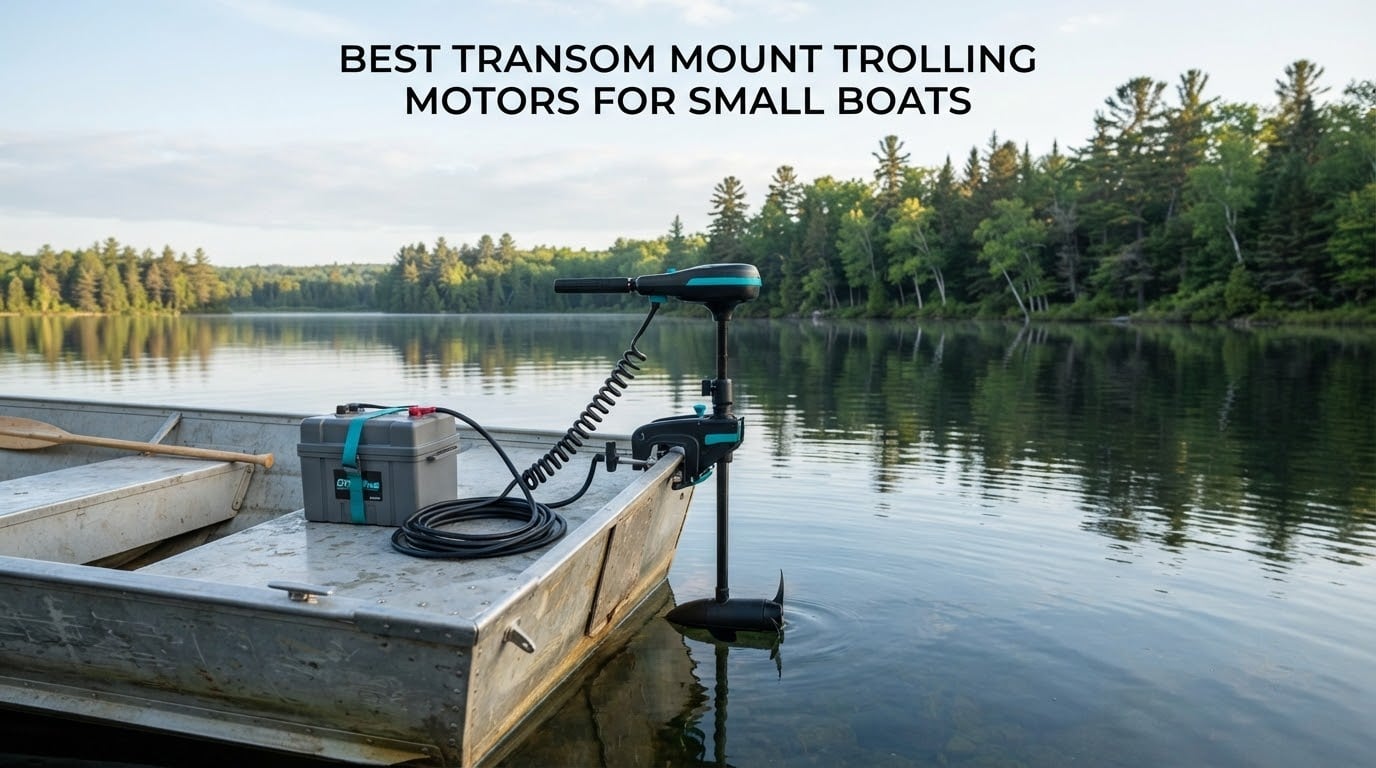
Choosing the best transom mount trolling motors for small boats comes down to three numbers: thrust, shaft length and battery capacity. Get any of them wrong and you end up with a motor that overheats, sits too shallow, or strands you a mile from the launch.
I have spent seasons running electric motors on jon boats, duck boats and 12-foot aluminum rigs, and the pattern is consistent. Transom mounts win on small craft for one reason above all: they clamp on, tilt up and come off in under a minute with no drilling, no bow cable and no hardware to lose. A bow mount gives you better trim and remote steering, but on a boat with a low transom or a flimsy deck it is often more commitment than the hull can carry.
Everything below was chosen against the same criteria: pounds of thrust against realistically loaded boat weight, shaft length measured against actual transom height, hardware that suits the water you fish, and control feel at the low speeds where trolling actually happens. I pulled owner feedback on runtime rather than trusting amp-hour claims, and I flagged the specific flaws reviewers repeat instead of the marketing line.
Nine motors made the cut, spanning 30 lb to 68 lb of thrust, 30 inch to 42 inch shafts, and everything from a battery-powered budget unit to a wireless remote system. Updated for 2026, this is the guide I wish I had before my first season on a 14-foot jon boat.
Last updated: October 2026
Table of Contents
- Our Top 3 Transom Mount Trolling Motors for Small Boats
- Comparing Every Transom Mount Trolling Motor in This Roundup
- 1. Newport NV-Series 55 – The Editor’s Choice Transom Motor for Mixed Water
- 2. Minn Kota Endura C2 30 – Built for Inflatable Boats and Light Craft
- 3. Intex 40lb Transom Motor – The Inflatable-Specific Pick with Weed Escape
- 4. PEXMOR 8 Speed Motor – The Budget Entry With a Full Feature List
- PEXMOR 8 Speed Electric Trolling Motor, Electric Outboard Boat Motor w/Adjustable Handle & LED Indicator, Transom Mounted for Saltwater, Kayak, Fishing Boat (Grey, 46 LBS)
- Thrust options and propeller hardware
- Battery indicator problems worth knowing
- Control feel and warranty length
- Who should buy it and who should skip it
- 5. Minn Kota Endura Max 55 – Digital Maximizer for Long Days
- 6. BODIOO 68lb Thrust – Maximum Push From a Compact 12V Unit
- 68LB Thrust Trolling Motor 8 Speed Electric Outboard Motor Boat Kayak Motor with 6’’ Adjustable Handle 30” Shaft Length & LED Indicator Transom Mounted for Kayak, Fishing Boat
- Freshwater only, and that is the deciding factor
- Bracket control and low voltage cutoff
- Warranty and build compromises
- Who should buy it and who should skip it
- 7. VEVOR 55lb Thrust – Sealed Motor Head and the Longest Handle Range
- VEVOR Electric Trolling Motor, Transom Mounted Outboard Boat Motors 12V 55lbs Thrust, 8-Speed Electric Boat Engine w/Battery Indicator, for Kayaks, Fishing Boats on Freshwater/Saltwater, 30-In Shaft
- Thrust, weight and what 20.3 pounds feels like
- Salt water readiness and voltage options
- Ratings spread and what to watch
- Who should buy it and who should skip it
- 8. Minn Kota Endura C2 30 – The Long-Term Proven Standard
- 9. AQUOS Haswing 55 – Wireless Remote Control From Shore
- How to Choose a Transom Mount Trolling Motor Your Boat Can Handle
- Match thrust to loaded boat weight with the 2 lb per 100 lb rule
- Pick 12V or 24V based on how hard you fish
- Measure your transom before choosing a shaft length
- Freshwater or saltwater hardware decides how long the motor lasts
- Tiller, hand control or remote: choose your steering
- Size the battery with runtime math, not amp-hour marketing
- Thin transoms and the bow-mount adapter trick
- Running a trolling motor alongside an outboard or kicker
- Frequently Asked Questions
- What is the best trolling motor for a small boat?
- How big of a boat will a 55lb trolling motor push?
- Which is better, a 12 volt or 24 volt trolling motor?
- How long will a 100Ah battery run a 55lb trolling motor?
- What size battery is recommended for a 55lb thrust trolling motor?
- Can I use a freshwater trolling motor in salt water?
- Which Transom Mount Trolling Motor Should You Buy?
Our Top 3 Transom Mount Trolling Motors for Small Boats
If you want the short answer, these three cover almost every small boat setup. The Newport NV-Series is the one I put on boats with the widest range of jobs, the Minn Kota Endura C2 30 is the proven lightweight workhorse, and the Minn Kota Endura Max 55 is the pick when the boat is heavier or the day is longer.

Newport NV 55lb Saltwater
EDITOR'S CHOICE
- 55 lb thrust on 12V
- 30 inch shaft
- 5 LED battery meter
- 50 amp breaker included

Minn Kota Endura C2 30
MOST COMPACT
- 30 lb thrust
- 15 lb motor weight
- 5 forward and 3 reverse
- composite shaft
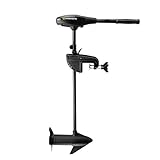
Minn Kota Endura Max 55
MOST VERSATILE
- 55 lb thrust
- 42 inch shaft
- Digital Maximizer
- push-to-test battery meter
As an Amazon Associate we earn from qualifying purchases. CERTAIN CONTENT THAT APPEARS ON THIS SITE COMES FROM AMAZON. THIS CONTENT IS PROVIDED 'AS IS' AND IS SUBJECT TO CHANGE OR REMOVAL AT ANY TIME.
Comparing Every Transom Mount Trolling Motor in This Roundup
Thrust, shaft length and control type are the three specs that decide whether a motor suits a particular hull. This table lines all nine side by side so you can rule out the wrong fit before you read further.
| No | Gear | Why it earns bag space | Check |
|---|---|---|---|
| 1 | |
|
Check Latest Price |
| 2 | |
|
Check Latest Price |
| 3 | 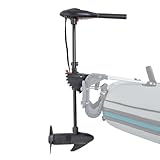 |
|
Check Latest Price |
| 4 |  |
|
Check Latest Price |
| 5 | |
|
Check Latest Price |
| 6 |  |
|
Check Latest Price |
| 7 |  |
|
Check Latest Price |
| 8 | |
|
Check Latest Price |
| 9 |  |
|
Check Latest Price |
As an Amazon Associate we earn from qualifying purchases, at no additional cost to you. CERTAIN CONTENT THAT APPEARS ON THIS SITE COMES FROM AMAZON. THIS CONTENT IS PROVIDED 'AS IS' AND IS SUBJECT TO CHANGE OR REMOVAL AT ANY TIME.
Worth noting before the individual reviews: the thrust figures on this list are manufacturer ratings measured under lab conditions. Real-world pushing power falls off with a heavy load, a choppy surface and a foul prop, which is why I keep recommending a motor one tier above the bare minimum.
1. Newport NV-Series 55 – The Editor’s Choice Transom Motor for Mixed Water
Newport NV-Series 55lb Thrust Saltwater Transom Mounted Trolling Electric Trolling Motor w/ LED Battery Indicator & 30″ Shaft (23M1000203)
- 55 lb thrust on 12V
- 30 inch shaft
- 5 forward / 3 reverse speeds
- 50 amp breaker included
Pros
- Rated for salt water
- Quiet enough for clear water
- Adjustable mount angle height and direction
- LED battery meter on the head
- 50 amp circuit breaker in the box
Cons
- Battery and deep cycle wiring sold separately
- Top speed near 4 mph suits slow trolling only
- Only a 2 year manufacturer warranty
As an Amazon Associate we earn from qualifying purchases, at no additional cost to you. CERTAIN CONTENT THAT APPEARS ON THIS SITE COMES FROM AMAZON. THIS CONTENT IS PROVIDED 'AS IS' AND IS SUBJECT TO CHANGE OR REMOVAL AT ANY TIME.
This is the motor I keep reaching for when a boat has to do more than one job. A 14-foot aluminum boat that trolls an inland reservoir in June and runs the flats in September is exactly the case it was built for, and the manufacturer lists salt water among the recommended uses.
Owners consistently describe it as quiet enough not to spook fish and strong enough to run a full day without overheating. The 3-blade propeller delivers the low-end torque you want when dragging a crankbait across a weedy ledge, and the top speed of roughly 4 mph keeps expectations honest: this is a slow-precision motor, not a way to cross a lake at speed.
The detail I appreciate most is the mount. Angle, height and steering direction are all adjustable and then lockable, which means one motor can serve a high-sided jon boat in the morning and a low transom in the afternoon. On the in-depthoutdoors forum, long-time owners consistently name the model series rather than the brand when describing a motor that has lasted, and this is the series most often mentioned for transom work.
Thrust and what 55 pounds actually moves
With 55 lb of rated thrust on 12 volts, this sits in the middle of the range where a loaded small boat moves without straining. On the forum-sourced rule of thumb that owners actually use, budget roughly 2 lb of thrust per 100 lb of fully loaded boat weight, and you are looking at comfortable coverage for boats up to the mid-20s in total loaded weight.
The catch is electrical. Maximum amp draw is 52A, and the motor ships with a 50 amp circuit breaker that should be used to protect against voltage surges. That single number is the whole reason a big Group 24 or Group 27 deep cycle battery matters here, and it is worth planning the electrical side before the motor goes on the boat.
Shaft length and transom height
The 30 inch shaft is the conservative choice, and it works well on typical small jon boats where the transom is not especially tall. Measure from the top of the transom down to the waterline, then allow enough shaft to keep the prop fully submerged with a few inches of depth adjustment left.
On higher-sided boats the 30 inch shaft can come up short, and running a prop that breaks the surface wastes a lot of the 55 lb rating. The good news is this model has a 46 lb, 36 lb, 62 lb and 86 lb variant, so if the shaft feels marginal you can move up or down within the same family rather than changing brands.
Controls, battery meter and daily usability
Eight speed settings, five forward and three reverse, on a 6 inch telescoping tiller handle is the standard layout in this class and it does the job. The 5 LED battery meter on the head gives a clear charge status without a separate gauge, which removes one more piece of wiring from the install.
Reviewers do call out the reverse as adequate rather than strong, so if you plan to back out of tight marina slips rather than just reverse a few feet, test it before you rely on it. For trolling work, forward control is smooth and predictable.
Who should buy it and who should skip it
Buy this one if your boat sees both fresh and salt water, if you want a real battery meter in the head, and if you would rather not source a breaker separately. It is the motor I recommend to angler after angler who asks for one answer that covers a lot of water.
Skip it if your budget is genuinely tight, because the battery, cables and breaker are all extra purchases. Also skip it if you need to reposition quickly across open water, since the roughly 4 mph top speed is a trolling number and nothing more.
As an Amazon Associate we earn from qualifying purchases, at no additional cost to you. CERTAIN CONTENT THAT APPEARS ON THIS SITE COMES FROM AMAZON. THIS CONTENT IS PROVIDED 'AS IS' AND IS SUBJECT TO CHANGE OR REMOVAL AT ANY TIME.
2. Minn Kota Endura C2 30 – Built for Inflatable Boats and Light Craft
Minn Kota Endura C2 Transom-Mount Electric Trolling Motor – 30 Lb. Thrust, 30 In. Shaft, Freshwater
- 30 lb thrust
- 30 inch shaft
- 15 pounds class build
- 5 forward / 3 reverse
Pros
- Highest average rating in the group
- Indestructible composite shaft
- 10 position lever lock bracket
- Power Prop handles heavy vegetation
- Push-to-test battery meter
Cons
- 30 lb thrust covers only small craft
- Composite shaft flexes more than aluminum
- Five forward speeds give coarse low speed control
As an Amazon Associate we earn from qualifying purchases, at no additional cost to you. CERTAIN CONTENT THAT APPEARS ON THIS SITE COMES FROM AMAZON. THIS CONTENT IS PROVIDED 'AS IS' AND IS SUBJECT TO CHANGE OR REMOVAL AT ANY TIME.
Minn Kota lists inflatable boats as a recommended use for this motor, and that tells you exactly what it was designed around. The whole unit sits in the lightweight end of this roundup, which matters when the transom is a fabric and vinyl panel rather than a solid aluminum plate.
It carries a 4.7 average across its reviews, the highest rating in the group, with a large share of five-star ratings. Owners single out the shaft and the bracket rather than raw power, which is a sensible priority when the boat itself weighs very little.
Composite shaft and what it tolerates
The indestructible composite shaft resists flexing, warping and UV damage, and it will not kink the way a thin aluminum shaft can if you hit structure. The tradeoff owners mention is that composite is less rigid than aluminum under heavy impact, so if you work rocky shorelines constantly, keep expectations realistic.
For inflatable hulls, inflatable pontoon boats and light aluminum craft, that resilience is exactly the property you want. Salt water needs a rinse, and the manufacturer rates this one for fresh water only.
The lever lock bracket and depth control
The 10-position lever lock bracket lets you set the angle once and lock it, then adjust depth with a single movement as conditions change. Multiple owners point to this as the feature that makes the motor quick to deploy after a move rather than a fiddly setup every time.
On r/boats, owners note that a transom mount comes off the craft the same way an outboard does, so you can move the motor between boats without tools. This model is light enough to be carried by one adult, which makes that genuinely practical.
Thrust limits you should plan around
Thirty pounds of thrust is the honest ceiling here. It is ample for canoes, duck boats, kayaks and small jon boats carrying a single angler, and thin for anything heavier with a second person aboard.
The Power Prop supplied for 3-1/4 inch motor diameters is designed to push through heavy vegetation, with the prop pin, nut and washer included. That matters more on weed-choked small lakes than the raw thrust number does, because fouling is what actually ends your day.
Who should buy it and who should skip it
This is the motor for an inflatable, a canoe, a kayak or a very light jon boat where weight matters more than grunt. The rating backs that up, and the composite shaft is the quiet hero of the design.
Skip it if two people ride in the boat regularly, if you fish heavy current where you need steering authority, or if your water is salt. The 5-forward-speed control is also coarse at the very lowest end, which makes fine drift work harder than it should be.
As an Amazon Associate we earn from qualifying purchases, at no additional cost to you. CERTAIN CONTENT THAT APPEARS ON THIS SITE COMES FROM AMAZON. THIS CONTENT IS PROVIDED 'AS IS' AND IS SUBJECT TO CHANGE OR REMOVAL AT ANY TIME.
3. Intex 40lb Transom Motor – The Inflatable-Specific Pick with Weed Escape
INTEX Transom Electric Trolling Motor for Inflatable Boat, 40lb Thrust
- 40 lb thrust
- 5 forward / 3 reverse speeds
- Weed escape function
- 17 pounds unit weight
Pros
- Weed escape switches the prop between forward and reverse
- Control panel carries battery
- dry run and overload indicators
- 8 position tiller with a 6 inch extension
- Auto power modulation extends battery life
Cons
- No manufacturer warranty
- All plastic construction
- 12 percent of ratings are one star
- Battery and deep cycle battery not included
As an Amazon Associate we earn from qualifying purchases, at no additional cost to you. CERTAIN CONTENT THAT APPEARS ON THIS SITE COMES FROM AMAZON. THIS CONTENT IS PROVIDED 'AS IS' AND IS SUBJECT TO CHANGE OR REMOVAL AT ANY TIME.
If your boat is an inflatable, this motor is built for the hull rather than adapted to it. Intex lists compatibility with the Challenger 3, Seahawk 2, 3 and 4, Excursion 4 and 5, and Mariner 3 and 4, which tells you the mounting geometry was tested against real inflatable transoms.
The weed escape function is the feature no competitor in this list has. It rapidly switches the propeller between forward and reverse so you can clear vegetation without reaching for the tiller and cutting your line, which on a weedy pond is the difference between a good hour and a ruined one.
Control panel and the indicator cluster
The control panel carries a battery meter plus dry operation and overload indicators, and the auto power modulation manages draw to extend battery life. Reviewers do not trust the meter as a precise gauge, and forum complaints about unreliable battery meters on budget motors are among the most common pain points, so treat it as a rough warning light rather than a fuel gauge.
The multi-position tiller extends 6 inches and tilts into 8 positions, which is unusually flexible for a motor at this level. On a wide inflatable you want steering from the center console, and this handle range makes that workable.
Weed escape and shallow water work
Eight speed settings, five forward and three reverse, plus the weed escape function, give this unit more low-speed flexibility than most. The 40 lb of thrust is a sensible match for mid-size inflatable dinghies and inflatable pontoon boats carrying one or two people.
Because the shaft is a fixed-length design suited to the inflatable transoms it was designed for, this is not a motor to stretch onto a deep-V aluminum boat. Match it to the hull family it was engineered for.
Build quality and the warranty gap
This is where the rating splits. Positive reviews focus on the weed escape mode, the indicators and the inflatable fit, while negative ones point at the all-plastic construction and the absence of any manufacturer warranty. A 12 percent one-star share is the second highest in this roundup, and it tracks with the lack of coverage.
The included components are 12V battery cables and an adjustable mounting bracket. A deep cycle battery is not included, so budget for the electrical side separately.
Who should buy it and who should skip it
Buy it if you own an Intex inflatable and fish water thick with vegetation. The weed escape function and the hull-specific fit make it a genuinely better tool for that job than a generic motor at a similar thrust level.
Skip it if you want warranty backing, if your water is salt and you plan to keep the motor year round, or if you need hardware that takes hard knocks. The no-warranty position is a real risk on a component that lives in a wet environment.
As an Amazon Associate we earn from qualifying purchases, at no additional cost to you. CERTAIN CONTENT THAT APPEARS ON THIS SITE COMES FROM AMAZON. THIS CONTENT IS PROVIDED 'AS IS' AND IS SUBJECT TO CHANGE OR REMOVAL AT ANY TIME.
4. PEXMOR 8 Speed Motor – The Budget Entry With a Full Feature List
PEXMOR 8 Speed Electric Trolling Motor, Electric Outboard Boat Motor w/Adjustable Handle & LED Indicator, Transom Mounted for Saltwater, Kayak, Fishing Boat (Grey, 46 LBS)
- 26 to 86 lb thrust options
- 5 forward and 3 reverse
- 1 to 10 LED battery indicator
- Push-button shaft angle adjustment
Pros
- Lowest cost in the roundup
- Thrust choices from 26 lb to 86 lb
- Telescoping tiller extension helps side mounted setups
- Backup propellers on higher thrust models
- Quiet running with smooth low speed control
Cons
- Indicator light has no off switch
- Battery meter reads late
- Bracket feet can detach and rattle
- Occasionally jumps to high speed from off
As an Amazon Associate we earn from qualifying purchases, at no additional cost to you. CERTAIN CONTENT THAT APPEARS ON THIS SITE COMES FROM AMAZON. THIS CONTENT IS PROVIDED 'AS IS' AND IS SUBJECT TO CHANGE OR REMOVAL AT ANY TIME.
At the bottom of the cost range, the feature list is longer than you would expect. Five forward and three reverse speeds, a 6 inch telescoping tiller, push-button shaft angle adjustment and knob depth control all come standard, along with a 1 to 10 LED battery capacity indicator where 1 to 3 red lights signal low power.
Owners call it excellent value and report multi-hour outings on a 100Ah group 29 deep cycle battery. That combination of thrust choice and runtime is exactly what a first-time small boat buyer is looking for.
Thrust options and propeller hardware
This is the entry-level thrust class in the PEXMOR line, with 26, 36, 45, 55 and 86 lb variants. That range matters because you can pick the motor to the boat rather than settling for whatever thrust happens to be on sale, and owners confirm the lower end is adequate for 12 foot jon boats and small kayaks.
The three-bladed propeller is included, and higher thrust models come with additional 2- and 3-blade props as spares. Having a spare prop on a motor you use in vegetation is worth more than it sounds.
Battery indicator problems worth knowing
The most common criticisms are all about the indicator. It cannot be switched off, so it stays lit after you finish, and it does not register a low reading until the battery drops to roughly 12.5 volts, which is later than you would want to be told.
Other hardware notes from owners: the mounting screw feet can detach and rattle inside the bracket, and the motor will occasionally jump to a high speed when the tiller moves from off to speed 1. Battery leads are short and no alligator clamps are included, so plan the wiring.
Control feel and warranty length
Quiet running and smooth low-speed control are praised by owners, and the telescoping tiller extension made a real difference for side-mounted setups. Assembly is straightforward, which matters for a first install.
The warranty is 1 year, the second shortest in this roundup. For a motor at this price that is understandable, but it is a shorter commitment than the two-year coverage the Minn Kota options carry.
Who should buy it and who should skip it
Buy it if you are outfitting a small boat for the first time on a tight budget and you want the full eight-speed layout plus a spare prop. The thrust range means you can grow into a bigger boat later without changing brands.
Skip it if you are fussy about a battery meter you can trust, if a light that stays on all night bothers you, or if losing reverse control in tight quarters would frighten you. The jump-to-high-speed behaviour is the one fault I would want resolved with a quick test on the water.
As an Amazon Associate we earn from qualifying purchases, at no additional cost to you. CERTAIN CONTENT THAT APPEARS ON THIS SITE COMES FROM AMAZON. THIS CONTENT IS PROVIDED 'AS IS' AND IS SUBJECT TO CHANGE OR REMOVAL AT ANY TIME.
5. Minn Kota Endura Max 55 – Digital Maximizer for Long Days
Minn Kota Endura Max Transom-Mount Electric Trolling Motor – 55 Lb. Thrust, 42 In. Shaft, Freshwater
- 55 lb thrust
- 42 inch shaft
- Digital Maximizer efficiency
- Push-to-test battery meter
Pros
- Digital Maximizer extends runtime on a single charge
- 55 lb thrust moves heavier jon boats
- Variable speed control conserves battery
- Reinforced composite bracket holds position
- Push-to-test meter is easy to read
Cons
- 42 inch shaft is long for very small boats
- Most expensive Minn Kota option in the group
- 76 percent five star share is more mixed than the C2
As an Amazon Associate we earn from qualifying purchases, at no additional cost to you. CERTAIN CONTENT THAT APPEARS ON THIS SITE COMES FROM AMAZON. THIS CONTENT IS PROVIDED 'AS IS' AND IS SUBJECT TO CHANGE OR REMOVAL AT ANY TIME.
The Endura Max is the answer when the day is longer than the battery. Digital Maximizer technology manages power draw to extend run time on a single charge, and with 55 lb of thrust paired to it, you get both the pulling power and the efficiency to use it.
Variable speed control is the practical part. Instead of running speed 5 and burning the battery, you hold a low notch for hours, and owners report that difference clearly. The 10-position lever lock bracket holds its setting without creeping, which matters on a long drift.
Why the 42 inch shaft is a real decision
A 42 inch shaft is the longest here, and it is a genuine trade. On a high-sided jon boat or aluminum fishing boat it puts the prop deep enough to stay fully submerged, which protects both the rating and the weedless bite. On a kayak or a very low transom it is unusable, and the shaft will foul the hull.
If you are unsure, this family also comes in 45 lb and 36 inch and 55 lb and 36 inch configurations, so the same motor can be matched to a different boat without changing brand.
Efficiency and battery planning
The efficiency claim is measured against running a motor flat out, so the honest read is that disciplined speed control pays. A battery gauge plan is essential, and our guide to the best deep cycle batteries for trolling motors covers the sizing math in more detail.
Forum discussion about battery choice for small boats tends to split between a single 24V lithium pack and two 12V AGM batteries. Whichever route you take, the motor-side spec to match is the same: the push-to-test meter on the head tells you when you are getting low.
Ratings spread and what it means
At a 4.4 average with 76 percent five-star ratings and a 7 percent two-star share, this is more mixed than the Endura C2 in the same brand. Part of that is the price step up from the C2 line, which owners name directly as the main barrier.
The indestructible composite shaft and the reinforced composite bracket are consistent with the rest of the range, and both carry a 2 year manufacturer warranty.
Who should buy it and who should skip it
Buy it if you fish all day in a boat with a tall transom and you are tired of watching a battery gauge fall while you troll. The efficiency work and the 55 lb of thrust are the reason to spend more here.
Skip it if your boat is a kayak, a duck boat with a low transom, or anything where a 42 inch shaft will hit the bottom constantly. In that case, step down to a 36 inch variant or a different motor entirely.
As an Amazon Associate we earn from qualifying purchases, at no additional cost to you. CERTAIN CONTENT THAT APPEARS ON THIS SITE COMES FROM AMAZON. THIS CONTENT IS PROVIDED 'AS IS' AND IS SUBJECT TO CHANGE OR REMOVAL AT ANY TIME.
6. BODIOO 68lb Thrust – Maximum Push From a Compact 12V Unit
68LB Thrust Trolling Motor 8 Speed Electric Outboard Motor Boat Kayak Motor with 6’’ Adjustable Handle 30” Shaft Length & LED Indicator Transom Mounted for Kayak, Fishing Boat
- 68 lb thrust
- Copper core motor
- 30 inch adjustable shaft
- Low voltage cutoff
Pros
- Highest thrust figure in the roundup
- Quiet at around 50dB
- Ten position 90 degree rotatable bracket
- Low voltage cutoff protects the battery
- Collapses for kayak storage
Cons
- Freshwater use only
- Six month warranty
- Plastic control box is water resistant not sealed
As an Amazon Associate we earn from qualifying purchases, at no additional cost to you. CERTAIN CONTENT THAT APPEARS ON THIS SITE COMES FROM AMAZON. THIS CONTENT IS PROVIDED 'AS IS' AND IS SUBJECT TO CHANGE OR REMOVAL AT ANY TIME.
Thrust is the headline here: 68 lb from a 12 volt unit in a package weighing about 20.72 lb with a 30 inch adjustable shaft. The copper core design and upgraded wiring do the work, and the motor is rated for 12V deep cycle batteries of 50Ah or more.
It runs at a stated noise level of around 50dB, which matters if you are working water where fish pressure is high or you simply do not want to hear the motor all day.
Freshwater only, and that is the deciding factor
The manufacturer states plainly that this is not intended for salt water use. That single limitation rules it out for coastal, estuarine and bay fishing, no matter how good the thrust number looks, and it is the most cited caveat in the reviews.
For a freshwater lake, pond or river boat, the specification is irrelevant. There is no saltwater-rated motor in this roundup that beats 68 lb of rated thrust at this level of compactness.
Bracket control and low voltage cutoff
The 90 degree rotatable bracket secures in 10 positions, and the collar-release depth adjustment is quick to change. On kayaks and inflatables, where you are steering from a seat rather than a console, that much steering authority is a real advantage.
The low-voltage cutoff reduces over-discharge, which protects the battery and stops you from flattening a pack without knowing it. The integrated LED voltage display gives low-level alerts, and the tool-free 3-blade 9.5 inch propeller installation means a swap takes no tools.
Warranty and build compromises
Six months of coverage is the shortest in this roundup, and it is the clearest tradeoff against the thrust figure. The plastic control box materials are only water resistant rather than sealed, which reinforces the freshwater-only framing.
Included items are a fin, prop pin and washer, propeller, a screwdriver and the manual. Collapsing the shaft for storage in a kayak compartment is straightforward, and the basic tool kit is a nice touch at this level.
Who should buy it and who should skip it
Buy it if you fish freshwater only, your boat is loaded heavier than the thrust-to-weight rule suggests, and you want the most pushing power available without moving up to a second battery. The quiet running is a genuine bonus for clear water.
Skip it if there is any salt water in your future, if a six month warranty makes you nervous, or if you need sealed electronics for a rough environment. A 30 inch shaft on a high transom would also leave the prop too shallow.
As an Amazon Associate we earn from qualifying purchases, at no additional cost to you. CERTAIN CONTENT THAT APPEARS ON THIS SITE COMES FROM AMAZON. THIS CONTENT IS PROVIDED 'AS IS' AND IS SUBJECT TO CHANGE OR REMOVAL AT ANY TIME.
7. VEVOR 55lb Thrust – Sealed Motor Head and the Longest Handle Range
VEVOR Electric Trolling Motor, Transom Mounted Outboard Boat Motors 12V 55lbs Thrust, 8-Speed Electric Boat Engine w/Battery Indicator, for Kayaks, Fishing Boats on Freshwater/Saltwater, 30-In Shaft
- 55 lb thrust on 12V
- Handle extends 6.3 to 10.6 inches
- Sealed aluminum motor head
- 20.3 pounds unit weight
Pros
- Corrosion resistant sealed head and alloy shaft for salt water
- Longest telescoping handle range in the group
- 55 lb thrust in a 20.3 lb package
- 3 blade prop reduces tangling
- Works with rafts and inflatables
Cons
- Among the lowest average ratings here at 4.1
- Only one propeller included
- Manual controls only on this variant
- Small review base of 43 ratings
As an Amazon Associate we earn from qualifying purchases, at no additional cost to you. CERTAIN CONTENT THAT APPEARS ON THIS SITE COMES FROM AMAZON. THIS CONTENT IS PROVIDED 'AS IS' AND IS SUBJECT TO CHANGE OR REMOVAL AT ANY TIME.
The telescopic handle here adjusts from 6.3 to 10.6 inches, the widest range in this roundup, and that single spec opens up a use case the others do not address well. Sitting at the transom or standing and steering over the bow are both comfortable positions.
The high-strength lightweight aluminum alloy shaft and the sealed waterproof aluminum motor head are the parts worth noting for corrosion. The manufacturer lists the motor for both fresh water and salt water use, with kayaks, canoes, rafts and inflatables all named as compatible hulls.
Thrust, weight and what 20.3 pounds feels like
Fifty-five pounds of thrust in a 20.3 lb package is a good power-to-weight ratio, and the 30 inch shaft keeps the total footprint small enough for a compact aluminum boat. A 3-blade propeller handles low-speed torque and reduces tangling in vegetation.
Shaft height and the transom mount bracket are both adjustable, which is how you get the prop submerged on a hull with a low transom. The unit is listed at a 30 inch shaft, so confirm your transom height before committing.
Salt water readiness and voltage options
The sealed motor head and alloy shaft are the reason this motor can be considered for coastal use, though you still need to flush it with fresh water after every trip. Sacrificial anode practice matters just as much here as on any saltwater setup.
This 12V model needs one 12V battery. The 24V versions in the same family require one 24V pack or two 12V batteries in series, which is worth knowing if you are planning a voltage upgrade later, and our marine GPS buying guide covers matching electronics on a small console.
Ratings spread and what to watch
At 4.1 stars across 43 ratings, this is tied with the AQUOS for the lowest average in the roundup, with 64 percent five-star and 12 percent one-star shares. The spread suggests more variability in assembly quality and finish than the Minn Kota options show.
Only one propeller is included, so buy a spare before you need it. Controls on this variant are manual only, and the low best sellers rank for the listing reflects limited market traction rather than a functional problem.
Who should buy it and who should skip it
Buy it if you stand while trolling, if you need a long adjustable handle for visibility over the bow, and if salt water is part of the picture. The sealed head and alloy shaft are the right call for coastal work at this thrust level.
Skip it if you want the most proven electronics on the market, since the rating spread is the widest here. Also skip it if you need a spare prop in the box, because only one is included.
As an Amazon Associate we earn from qualifying purchases, at no additional cost to you. CERTAIN CONTENT THAT APPEARS ON THIS SITE COMES FROM AMAZON. THIS CONTENT IS PROVIDED 'AS IS' AND IS SUBJECT TO CHANGE OR REMOVAL AT ANY TIME.
8. Minn Kota Endura C2 30 – The Long-Term Proven Standard
Minn Kota Endura C2 30 Freshwater Transom Mounted Trolling Motor (30″ Shaft)
- 30 lb thrust
- 30 inch shaft
- 15 pounds unit weight
- Smooth tilt and depth control
Pros
- 4.6 stars across nearly 2800 reviews
- Lightest motor in the roundup at 15 pounds
- Runs essentially silently
- Smoothest tilt release in its class
- Owners report 500 plus hours with no failures
Cons
- Weak reverse froths the water
- Bolted terminal instead of a plug connector
- Short motor foot needs a shim for a transducer
- Underpowered for larger jon boats with two people
As an Amazon Associate we earn from qualifying purchases, at no additional cost to you. CERTAIN CONTENT THAT APPEARS ON THIS SITE COMES FROM AMAZON. THIS CONTENT IS PROVIDED 'AS IS' AND IS SUBJECT TO CHANGE OR REMOVAL AT ANY TIME.
This is the one I recommend when a buyer wants the least uncertain option available. A 4.6 average across nearly 2,800 reviews is a much larger evidence base than anything else in this roundup, and multiple long-term owners report 500 plus hours of use with no failures.
At 15 pounds, it is the lightest motor here, which one adult can lift onto a transom single-handed. On the in-depthoutdoors forum, owners naming a series that has proven itself over years carry far more weight than a spec sheet, and this is one of those motors.
Forward control is excellent, reverse is not
Forward performance and quietness draw the strongest praise, particularly for canoes, 8 to 14 foot jon boats and inflatable pontoon boats. Speed settings 1 to 3 give good trolling precision for holding a line over structure.
Reverse is the most cited weakness across the reviews, described as frothing the water without producing much thrust. If you need meaningful reverse to back out of a tight slip, test it on the water first. For trolling, that limitation rarely comes up.
Bracket, tilt mechanism and depth control
The 10-position lever lock bracket with quick release and reinforced composite material is the part long-term owners rate most highly, along with the smoothest tilt release in this class. The smooth tilt mechanism and depth control let you get the prop shallower in shallow water without disassembling anything.
The Power Prop for 3-1/4 inch motor diameters ships with a prop pin, nut and washer, so a changeover is a two-minute job. Composite construction resists flexing, warping and UV damage, and the unit carries a two year warranty from Johnson Outdoors.
Wiring and accessory compromises
Two practical notes before you buy. The battery connection uses a bolted terminal end rather than a plug style connector, so plan your terminal hardware carefully and keep it sealed. The short motor foot will not accept a standard transducer without a shim workaround, which matters if you also plan to run a fish finder. Our guide to the best fish finders for small boats covers that install.
The lifting trigger can be awkward to operate when striking bottom, a small thing that becomes obvious the first time you hit structure with it.
Who should buy it and who should skip it
Buy it if you want the most thoroughly proven transom motor available, if the boat is a canoe, a kayak or a small jon boat carrying one angler, and if you care about a smooth tilt and a bracket that holds. It is freshwater rated.
Skip it if you regularly have two people in the boat, if reverse power is a deal breaker, or if you need a plug connector and a full-length motor foot for accessories. Thirty pounds of thrust is not a two-person motor.
As an Amazon Associate we earn from qualifying purchases, at no additional cost to you. CERTAIN CONTENT THAT APPEARS ON THIS SITE COMES FROM AMAZON. THIS CONTENT IS PROVIDED 'AS IS' AND IS SUBJECT TO CHANGE OR REMOVAL AT ANY TIME.
9. AQUOS Haswing 55 – Wireless Remote Control From Shore
AQUOS Haswing Transom Trolling Motor 12V 55lbs 39in with Wireless Remote
- 55 lb thrust on 12V
- 39 inch cast aluminum shaft
- 164 ft wireless remote
- Sacrificial anode fitted
Pros
- Only motor here with true wireless remote control
- 164 ft range with USB rechargeable remote
- Wired foot control adds 10 speed settings
- Stepless speed control on the hand remote
- Separated fin protects the propeller
Cons
- Most expensive option by a wide margin
- Remote control failures strand owners mid-trip
- Replacement remotes are costly
- Hard to steer with the handheld in any wind
- Three month warranty on the remote
As an Amazon Associate we earn from qualifying purchases, at no additional cost to you. CERTAIN CONTENT THAT APPEARS ON THIS SITE COMES FROM AMAZON. THIS CONTENT IS PROVIDED 'AS IS' AND IS SUBJECT TO CHANGE OR REMOVAL AT ANY TIME.
This is the only motor in the roundup where you can steer from the bank. The 2.4 GHz wireless remote reaches up to 164 feet, fits in a palm, includes a lanyard and recharges over USB, and a separate wired foot control with 10 speed settings is included for on-boat use.
Underneath the remote, the motor itself is well specified: 55 lb of thrust on 12 volts, a 39 inch cast aluminum shaft, a 0 to 85 degree tilt range, 29 inches of maximum depth adjustment and 3 level LED battery reader. It is suited to boats up to about 18 to 19 feet.
Salt water hardware and propeller protection
A sacrificial anode and encapsulated electronics are the two features that put this motor in saltwater territory, and the separated motor fin design protects the propeller from direct impact. Add the cast aluminum shaft and you have a build aimed at coastal use rather than a lake-only motor with a remote added.
The wired foot control offering 10 speed settings gives more granularity than the 5-speed hand remote, and the stepless speed control is the smoothest low-speed control in this roundup. If fine speed maintenance matters to you, that is worth a lot.
Where the reliability complaints sit
Remote electronics are the dividing issue, and it shows in the ratings. This motor carries a 4.1 average with a 14 percent one-star share, the highest negative concentration among these picks, and the complaints cluster on remote and control panel failures that can leave an owner unable to steer mid-trip.
Several reviewers note that customer service ultimately replaced a faulty control panel and then an entire motor, which is a meaningful mitigation. The company warranty covers the trolling motor for two years but the remote control and accessories for only three months, which is short for the component with this failure history.
Handling weight and remote ergonomics
At 26 pounds, this is the heaviest motor in the roundup and awkward on a kayak. It also has the widest footprint at 50 inches wide in the listed dimensions, so measure your transom and storage before committing.
Steering with the handheld remote in any wind is genuinely difficult, and owners say so directly. In a calm cove the range makes it a joy. In a breeze you will be back on the tiller or the foot control.
Who should buy it and who should skip it
Buy it if fishing alone from a shoreline, a dock or an anchored boat is your normal pattern, or if stepless speed control for fine drift work is your priority. The saltwater hardware and the separated fin are legitimate strengths.
Skip it if you are on a tight budget, if a three month warranty on the remote is not acceptable, or if you fish in wind often enough that handheld steering will frustrate you. A kayak is not the platform for a 26 pound motor.
As an Amazon Associate we earn from qualifying purchases, at no additional cost to you. CERTAIN CONTENT THAT APPEARS ON THIS SITE COMES FROM AMAZON. THIS CONTENT IS PROVIDED 'AS IS' AND IS SUBJECT TO CHANGE OR REMOVAL AT ANY TIME.
How to Choose a Transom Mount Trolling Motor Your Boat Can Handle
Every wrong turn in this category traces back to skipping one of these decisions. Work through them in order and the motor shortlist narrows on its own.
Match thrust to loaded boat weight with the 2 lb per 100 lb rule
The most repeated piece of advice across forums and competitor guides is a single number: budget 2 lb of thrust for every 100 lb of fully loaded boat weight. Fully loaded means the boat plus the people plus the tackle, cooler, battery and anchor, not the bare hull weight on the trailer.
Worked examples help. A 12 foot jon boat with one angler and gear often lands near 350 to 400 lb loaded, which points to a 30 to 36 lb motor as a sensible floor. The same hull with a second person and a heavier battery approaches 500 lb, and 55 lb of thrust becomes the right starting point. Add current, wind or a heavy canopy and step up a tier again.
Two pounds per hundred is a floor, not a target. Manufacturers measure thrust on an idealised boat, and a fouled prop or a choppy surface will take a meaningful bite out of the number before you notice anything is wrong.
Pick 12V or 24V based on how hard you fish
For most small boats, 12V on a single deep cycle battery is the right answer. It is simpler to wire, cheaper to charge and there is only one battery to secure, isolate and maintain. Every motor in this roundup except the optional 24V variants runs on 12V.
The case for higher voltage is efficiency. A 24V system draws roughly half the amps for a similar thrust, so runtime improves meaningfully for the same amp-hour capacity. The cost is complexity: one 24V pack or two 12V batteries in series, a charger rated for it, and a wiring run that is larger. On r/WalleyeFishing, anglers weighing a long shaft transom motor and 12V lithium pack against two 12V AGM batteries make exactly this trade, and most land on 12V for a single-boat build.
Our honest guidance: choose 24V only if you fish hard, all day, in current or heavy wind. Otherwise the extra wiring buys you nothing you will use.
Measure your transom before choosing a shaft length
Shaft length is the most commonly misjudged spec. Measure from the top of the transom to the waterline, then choose a shaft that puts the prop fully submerged with a few inches of depth adjustment remaining. Too short and the prop breaks the surface, wasting thrust and adding noise. Too long and it hits bottom, drags in weeds and makes the motor hard to deploy.
For most small jon boats and aluminum fishing boats, 30 to 36 inches covers the range well. A 42 inch shaft suits a high-sided transom, and it is genuinely wrong for a duck boat or kayak. On r/boats, owners note that a transom motor comes off the boat the way an outboard does, so you can move one motor between craft if you size the shaft for the shortest hull it has to serve.
Freshwater or saltwater hardware decides how long the motor lasts
Salt water attacks hardware quietly. The features that matter are a sacrificial zinc anode, encapsulated or potted electronics, sealed motor heads, and stainless rather than plated fasteners. Corrosion on cheap-brand rivets within a season is one of the most common complaints in the forum record.
Check the rated use before anything else. The BODIOO 68 is explicitly freshwater only, the Minn Kota Endura C2 models are freshwater rated, and the Newport NV-Series, VEVOR, Intex and AQUOS units are listed for salt water. Flushing with fresh water after every saltwater trip is non-negotiable regardless of rating, and inspecting the anode and hardware in the off season is the habit that keeps a motor alive.
If you only fish an inland lake, a saltwater-rated motor is nice insurance for the future but not a requirement today. If salt water is in the plan, treat it as a requirement.
Tiller, hand control or remote: choose your steering
A telescoping tiller is the default and the most durable option. It puts you in direct contact with the motor, it works with no electronics to fail, and the 6 inch extension gives enough reach for most seat positions. Every motor in this roundup except the AQUOS has one.
A hand control or wired foot control adds speed granularity. The AQUOS wired foot control offers 10 speed settings and its hand remote gives stepless control, which is the finest low-speed control available in this group. For drifting over structure at walking pace, that difference is real.
A wireless remote adds a capability no other option offers: steering from shore or from an anchored position. On r/bowfishing, owners report that a transom motor at the back was the only workable option and that it worked well for the job, which is a reminder that placement matters as much as control type.
Size the battery with runtime math, not amp-hour marketing
Runtime is the number anglers overestimate most badly. The calculation is simple: usable amp hours divided by average amp draw. The catch is that draw rises steeply with speed, and most people troll faster than they think.
Real owner figures from the research are the best guide. Owners running a 100Ah group 29 deep cycle reported 4 to 5 hour outings. Forum consensus on bassresource puts a full day at 100 to 120Ah, with 100Ah giving a little over 3 hours at typical trolling draw. A separate owner running 30 lb 12V motors on homemade 9 foot 6 inch kayaks got about 4 hours from a cheap 20Ah lawn mower battery, and another reported a 30Ah lawn mower battery lasting about 4 hours on a 30 lb motor. That last one is the clearest illustration of why a battery that is not deep cycle is not a battery at all.
Also remember that reverse drains the battery. Several of the motors here pull high amps at the top notch, so treat top speed as a repositioning tool rather than a cruising speed. A battery box with a breaker, a plug connector and a terminal block is where most of the reliability lives, and our deep cycle battery guide covers the chemistry choices including LiFePO4 against AGM.
Thin transoms and the bow-mount adapter trick
Mounts that do not fit thin or unusual transoms are asked about constantly in the forums and answered almost nowhere commercially. A clamp-depth mismatch on a thin aluminum jon transom or a foam kayak hull is the single most common install failure, so measure transom thickness against the bracket before you order.
There is a well-known workaround for putting a transom motor on the bow of a small utility boat. Owners on pnwflyfishing describe an adapter mount that lets a transom motor bolt to the front of a small boat for a modest outlay, and on r/bassfishing a commenter running a 45 lb thrust transom motor on the bow of a jon boat reports that it works great. It is worth considering when a bow position gives you a much better line of sight, which is the core advantage of a bow mount.
Running a trolling motor alongside an outboard or kicker
Boats with a kicker motor need a separate electrical path, not a shared one. Use an independent breaker and a separate battery or a battery selector that isolates the trolling circuit, so a fault in the trolling motor wiring never takes your outboard down with it. Route the trolling cable away from the outboard harness to avoid electrical interference, and secure the plug connection where spray cannot reach it.
The reverse comparison matters here. On r/WalleyeFishing, anglers treat a transom trolling motor as the cheaper second motor compared with a gas kicker, and the savings on fuel, weight and maintenance are the real argument. If you want both, plan the breaker and the isolation before the first install rather than after.
Frequently Asked Questions
What is the best trolling motor for a small boat?
The best trolling motor for a small boat is usually a transom mount, because it clamps on, tilts up and comes off in under a minute with no drilling. Size it by loaded boat weight using the 2 lb of thrust per 100 lb rule, so a 12 foot jon boat with one angler needs around 30 to 36 lb of thrust and a heavier two-person setup wants 55 lb. Match the shaft to your transom height, 30 to 36 inches for typical small boats.
How big of a boat will a 55lb trolling motor push?
A 55 lb thrust trolling motor comfortably moves small boats up to roughly 2,500 lb of fully loaded weight on calm water, which covers most jon boats, 12 to 16 foot aluminum fishing boats and duck boats carrying one or two anglers. Using the 2 lb thrust per 100 lb loaded weight rule, 55 lb points to about 2,750 lb of total loaded weight. In current or heavy wind, step up one tier for control.
Which is better, a 12 volt or 24 volt trolling motor?
For most small boats, 12V on a single deep cycle battery is the better choice because it is simpler to wire, cheaper to charge and needs only one battery to secure. A 24V system draws roughly half the amps for similar thrust, so runtime improves for the same amp-hour capacity, but it requires one 24V pack or two 12V batteries in series plus a matching charger and heavier wiring. Choose 24V only if you fish hard all day in current or wind.
How long will a 100Ah battery run a 55lb trolling motor?
A 100Ah battery will run a 55 lb thrust trolling motor for roughly 3 to 5 hours at normal trolling speed, based on owner reports of 4 to 5 hour outings on a 100Ah group 29 deep cycle. Runtime comes from usable amp hours divided by average amp draw, and draw rises steeply with speed, so holding a low notch roughly doubles the hours compared with running flat out. For a full day, 100 to 120Ah is the commonly recommended capacity.
What size battery is recommended for a 55lb thrust trolling motor?
A single Group 24 or Group 27 deep cycle battery rated at 100Ah or more is the standard recommendation for a 55 lb thrust transom motor, and 100 to 120Ah covers most full fishing days. A LiFePO4 lithium pack holds its voltage longer and adds real weight savings, while two 12V AGM batteries in series give you 24V and better efficiency. Match your charger to the chemistry and use a fused, breakered lead-acid setup if you choose AGM.
Can I use a freshwater trolling motor in salt water?
You can use a freshwater motor in salt water occasionally, but you will shorten its life, and a few models in this roundup are explicitly freshwater rated only. For regular salt water use, look for a sacrificial zinc anode, encapsulated or potted electronics, a sealed motor head and stainless rather than plated fasteners. Flush the motor with fresh water after every trip and inspect the anode and hardware in the off season.
Which Transom Mount Trolling Motor Should You Buy?
If your boat sees salt water, or you need one motor that handles everything from an inland lake to the flats, choose the Newport NV-Series 55. It is our Editor’s Choice and the most versatile unit in the roundup, rated for salt water, carrying a 5 LED battery meter and a 50 amp circuit breaker in the box, with mounts adjustable and lockable in angle, height and direction.
If your boat is a jon boat, duck boat, canoe or inflatable and you want the safest, most proven option, take the Minn Kota Endura C2 30. It has the largest review base in the group, the lowest weight at 15 pounds and a rating that has held up over a decade of ownership, provided you accept freshwater use and modest reverse power.
If you fish all day in a high-sided boat, the Minn Kota Endura Max 55 earns its extra cost through Digital Maximizer efficiency and a 42 inch shaft that keeps the prop submerged. For a tight budget on a small hull, the PEXMOR gives you the full eight-speed layout and a choice of thrust levels, while the Intex is the only motor here built around a weed escape function for inflatable boats and weedy water. If steering from shore matters, the AQUOS Haswing 55 is the only option with true wireless remote control, and you accept the remote reliability risk that comes with it.
Whichever one you choose, measure your transom before you order, size the battery for 100Ah or more, and run a fused, breakered circuit. Those three steps remove most of the problems anglers report in their first season. For the rest of your small boat kit, our guide to the best coolers for boats is the next piece worth reading.
Updated for 2026. If any spec here looks off against what you have on the boat, trust the manufacturer’s manual and measure twice.